


LinkedIn automation, run for you200 messages sent for you, in your voice · 10 places left · closes in Run my first campaign

Claude Code Skills for Sales: 6 Workflows That Replace 2-3 Days of Manual Work

AI Driven, Personalized Outreach on LinkedIn: Prosp 💜

Try Prosp Free200 messages sent for you · 10 places left
5/5 rated on Capterra·Used by 800+ agencies and sales teams
Skills8 sections
Section 1

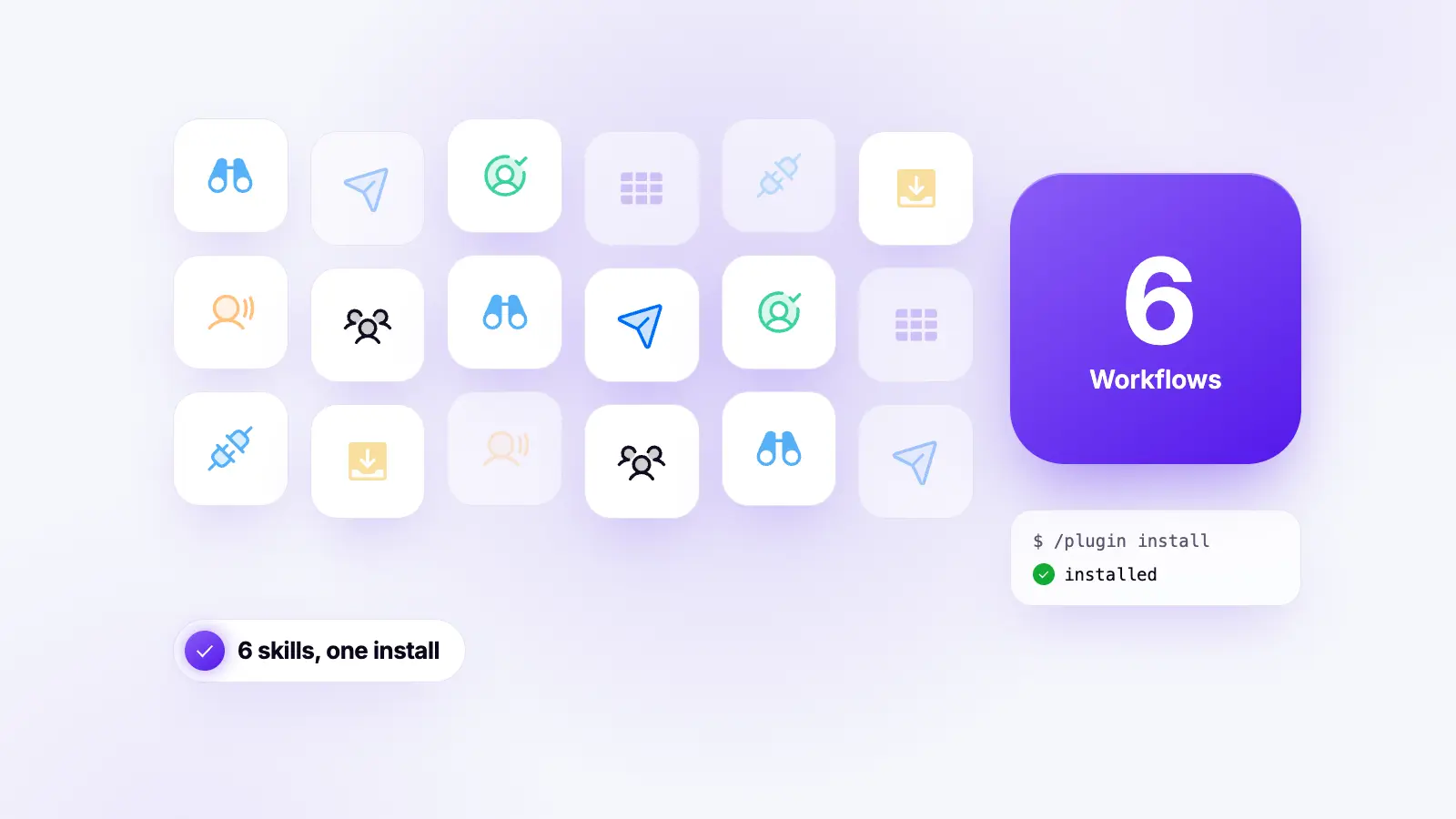
What Claude Code Skills Are and the 6-Skill Overview

Source: ostracon.ai/insights/claude-code-skills-for-sales

By: Ostracon AI (B2B AI agency, Helsinki)

Most sales teams use AI as a chatbot: open ChatGPT, paste a prompt, copy the output. That gets a 10-20% productivity boost. It does not work for account planning, pipeline reporting, or contract management, because those tasks need data from your CRM, meeting transcripts, proposal databases, and document storage. A chatbot cannot reach any of it.

A Claude Code skill is different. It is a reusable workflow stored in a SKILL.md file that connects directly to your tools: CRM, meeting recorder, e-signing platform, proposal database. One slash command triggers the whole chain.

Result for a part-time 5-person sales team: 70-80 hours saved per week. More than a 2x productivity boost.

What a Claude Code skill actually is

A skill is a markdown file called SKILL.md in a folder under ~/.claude/skills/. It contains:

  • Instructions for Claude on what to do step by step
  • API endpoints and authentication details
  • Templates for output formatting
  • Decision points where the user provides input

Run a slash command like /account-plan and Claude reads the instructions and executes the full workflow: calls APIs, reads files, queries databases, writes documents, sends emails.

The difference from a ChatGPT prompt: a skill remembers how your process works. It knows your CRM schema, your document templates, your email format. You do not re-explain context every time.

The 6 skills at a glance

Skill Manual time before Time now Tools connected
Account planning automation 2-3 days per account 15 minutes Twenty CRM, Apollo.io, LinkedIn, Outlook
Weekly sales report generator 1 hour, 52x a year Minutes Twenty CRM, Fireflies, Microsoft Teams
Proposal generation from transcripts Half a day Minutes Fireflies, Airtable, Claude Code
SOW generation 15-30 minutes (delayed days) 2 minutes Airtable, PDF generation (WeasyPrint)
Contract e-signing Small but delayed 30 seconds Documenso, SharePoint/OneDrive
CRM hygiene on autopilot Never actually happens Automatic Twenty CRM, Microsoft 365 Calendar, Airtable

Why skills beat prompts for sales ops

ChatGPT prompts are good for one thing: generating text from context you provide manually. That covers about 20% of sales ops work.

The other 80% is moving data between systems. CRM to document. Transcript to proposal. Proposal to SOW. SOW to e-signing. None of that works with prompts alone.

Skills handle the full chain. They read from your CRM, pull meeting transcripts, generate documents in your brand template, and push results back to where they belong. The AI does not just write. It operates.

Section 2

Skill 1: Account Planning Automation

Account planning should be the highest-value activity in B2B sales. In practice, it is 80% data collection and 20% thinking. This skill flips that ratio.

Tools connected: Twenty CRM, Apollo.io, LinkedIn, Outlook

The manual process this replaces

  • Open CRM, review existing contacts and deal history
  • Search LinkedIn for new decision-makers
  • Cross-reference titles, responsibilities, recent activity
  • Write an expansion strategy for the account
  • Draft personalised outreach emails
  • Update CRM with new contacts

That is 2-3 days per account. With larger clients, easily a full week.

How the skill works

  1. You pick a client from CRM
  2. The skill pulls company data and existing contacts automatically
  3. Apollo.io's API finds missing decision-makers: marketing directors, commercial leads, C-level
  4. A LinkedIn agent enriches each profile: current role, responsibilities, recent activity
  5. Claude builds an account-specific growth strategy: why this company, which decision-makers, what angle, what timing
  6. New contacts get pushed to CRM
  7. Personalised outreach emails draft into Outlook, ready to review and send

Total time: about 15 minutes. The salesperson spends time on strategy, not data entry.

Copy-paste prompt to build this skill

"Build me an account-planning skill for Claude Code.

When I run /account-plan [CLIENT NAME]:

1. Pull the client's company record, existing contacts, and deal history from [YOUR CRM]
2. Search Apollo.io for missing decision-makers at this company matching: [TARGET TITLES]
3. For each new contact found, enrich their profile via LinkedIn: current role, responsibilities, recent activity
4. Build an account-specific growth strategy: why this company, which decision-makers to prioritise, what angle to use, what timing makes sense
5. Push any new contacts found back into [YOUR CRM]
6. Draft personalised outreach emails for the top 3 decision-makers into [Outlook/Gmail], ready for me to review and send

Show me the full strategy and draft emails before anything is sent."
Section 3

Skill 2: Weekly Sales Report Generator

Every week, the same routine: open CRM, walk the pipeline, compare to last week, write a summary, add meeting notes, send to the team. An hour of work that repeats 52 times a year.

Tools connected: Twenty CRM, Fireflies, Microsoft Teams

How the skill works

  1. Pulls the entire pipeline from CRM: opportunities, stages, amounts
  2. Loads last week's snapshot for comparison
  3. Calculates changes automatically: deals won, lost, stage movements, new opportunities, value changes
  4. Pulls the latest sales meeting transcript from the meeting recorder API (Fireflies)
  5. Extracts action items straight from the conversation
  6. You add context: reasons for losses, next steps on big deals, CRM corrections
  7. The finished report generates as a Teams message
  8. A new pipeline snapshot saves to CRM Notes for next week's comparison

The report is based on actual CRM records and meeting transcripts, not memory-based estimates written in a rush on Friday afternoon.

Copy-paste prompt to build this skill

"Build me a weekly sales report skill for Claude Code.

When I run /weekly-report:

1. Pull the full pipeline from [YOUR CRM]: all opportunities, stages, amounts
2. Load last week's pipeline snapshot from [WHERE YOU STORE IT, e.g. CRM Notes]
3. Calculate what changed: deals won, deals lost, stage movements, new opportunities, value changes
4. Pull the latest sales team meeting transcript from [FIREFLIES OR YOUR MEETING RECORDER]
5. Extract action items from the transcript
6. Ask me for any additional context: reasons for losses, next steps on big deals, corrections needed
7. Generate a clean summary formatted for [MICROSOFT TEAMS / SLACK]
8. Save a new pipeline snapshot back to CRM for next week's comparison

Format the report with: pipeline overview, key changes this week, action items, and risks to watch."
Section 4

Skill 3: Proposal Generation From Meeting Transcripts

Writing proposals should be fast. It never is, because you have to reconstruct the conversation from memory before you can write anything. Details slip. Scope creeps. Half a day disappears.

Tools connected: Fireflies, Airtable, Claude Code

How the skill works

  1. Pulls the latest client meeting transcript from Fireflies
  2. Context comes from the actual conversation, not from memory
  3. Claude drafts the full proposal: situation overview, proposed scope, deliverables, timeline, pricing
  4. You review and iterate together: additions, cuts, tone adjustments
  5. One command publishes it to Airtable
  6. An automation picks up the data and publishes it as a branded web page

Proposal quality depends on how well you understand the client's situation. When context comes from the actual transcript instead of notes scribbled during the meeting, proposals land closer to what the client actually needs.

Copy-paste prompt to build this skill

"Build me a proposal-generation skill for Claude Code.

When I run /draft-proposal [CLIENT NAME]:

1. Pull the latest meeting transcript for this client from [FIREFLIES]
2. From the transcript, extract: the client's situation, stated problems, requirements mentioned, budget signals, timeline expectations
3. Draft a full proposal with these sections: situation overview, proposed scope, deliverables, timeline, pricing
4. Use our standard proposal structure: [PASTE YOUR TEMPLATE STRUCTURE OR REFERENCE FILE]
5. Show me the draft and let me iterate: I will ask for additions, cuts, or tone adjustments
6. Once approved, publish the final version to [AIRTABLE BASE/TABLE]

Do not invent requirements that were not mentioned in the transcript. If something is unclear, flag it as a question rather than assuming."
Section 5

Skill 4: SOW Generation

The proposal is approved. The client wants to start. Now you need a Statement of Work covering scope, deliverables, timeline, payment schedule, and terms. It is 15 minutes of copy-paste, formatting, and PDF export, boring enough that it sits on the to-do list for a day or two.

Tools connected: Airtable, PDF generation (WeasyPrint)

How the skill works

  1. Pulls the approved proposal from Airtable
  2. All deliverables, phases, and pricing come directly from the proposal data, no re-entry
  3. Asks for the specifics that are not in the proposal: payment schedule, start date, special terms
  4. Claude generates a complete SOW document using your branded template
  5. The document exports as a PDF with embedded fonts and logos
  6. The finished PDF saves to the client folder

From approved proposal to signed-ready SOW in about 2 minutes.

Copy-paste prompt to build this skill

"Build me a SOW-generation skill for Claude Code.

When I run /generate-sow [CLIENT NAME]:

1. Pull the approved proposal for this client from [AIRTABLE BASE/TABLE]
2. Extract: deliverables, phases, pricing, scope from the proposal data
3. Ask me for anything not already in the proposal: payment schedule, start date, special terms
4. Generate a complete SOW using our branded template: [REFERENCE YOUR TEMPLATE FILE OR PASTE STRUCTURE]
5. Export as a PDF with our logo and fonts embedded
6. Save the finished PDF to [CLIENT FOLDER LOCATION: SharePoint/OneDrive/Google Drive path]

The SOW must match the proposal exactly on scope and pricing. Flag any discrepancy before generating."
Section 6

Skill 5: Contract E-Signing

The contract is ready. The PDF is in the folder. Then you need to open the e-signing platform, upload the file, add signers, position signature fields, and send. Small task. But one of those that always gets pushed to tomorrow.

Tools connected: Documenso, SharePoint/OneDrive

How the skill works

  1. Finds contract files in the client folder: Frame Agreement, SOW, or both
  2. You pick which document to send
  3. Uploads via the Documenso API with signature fields placed on the last page
  4. Signers get added: names and emails
  5. The contract goes out for e-signature with one command

30 seconds instead of sitting on the to-do list for a day or two.

Copy-paste prompt to build this skill

"Build me a contract e-signing skill for Claude Code.

When I run /send-for-signature [CLIENT NAME]:

1. Find contract files in the client folder at [SHAREPOINT/ONEDRIVE PATH]: look for Frame Agreement, SOW, or both
2. Ask me which document(s) to send if more than one is found
3. Upload the selected document via the [DOCUMENSO] API
4. Place signature fields on the last page automatically
5. Add the signers: ask me for names and emails if not already known
6. Send for e-signature

Confirm the document and signers with me before sending."
Section 7

Skill 6: CRM Hygiene on Autopilot

Every sales leader knows the problem. CRM data decays the moment it is entered. Contacts change jobs. New stakeholders show up in meetings but never make it into the system. Opportunities exist in someone's head but not in the pipeline. The fix is always "everyone needs to update CRM." Nobody does.

Tools connected: Twenty CRM, Microsoft 365 Calendar, Airtable

How the skill works

The skill cross-references your calendar with your CRM. Every external meeting gets checked: does the company exist in CRM? Do the attendees? Is there an open opportunity?

  1. Pulls 2 weeks of calendar data from Microsoft 365
  2. Filters out internal meetings
  3. For every external meeting, matches the domain against CRM companies using fuzzy logic ("elisa.fi" matches "elisa.com", "teliacompany.com" matches "telia.fi")
  4. Checks if meeting attendees exist in CRM as contacts
  5. Checks if there is an open opportunity for this company
  6. Scores each contact before suggesting additions: a 1:1 meeting about a proposal review scores high, being one of 23 attendees in a weekly standup scores low
  7. Only relevant contacts get suggested

Output: a structured report covering companies without opportunities, contacts missing from CRM, domain mismatches, and empty fields. With one confirmation, the skill creates missing companies, adds contacts, opens opportunities, and fixes domain records.

Copy-paste prompt to build this skill

"Build me a CRM hygiene skill for Claude Code.

When I run /crm-hygiene:

1. Pull the last 2 weeks of calendar events from [MICROSOFT 365 / GOOGLE CALENDAR]
2. Filter out internal meetings, keep only external meetings
3. For each external meeting, match the attendee email domain against companies in [YOUR CRM] using fuzzy matching (handle cases like .fi vs .com, or different company name spellings for the same brand)
4. For each match, check: does this company exist in CRM? Are the attendees added as contacts? Is there an open opportunity?
5. Score each potential new contact based on meeting context: a small focused meeting about a specific deal scores high, a large group meeting (10+ attendees) scores low
6. Only flag contacts above a relevance threshold for me to review
7. Produce a structured report: companies missing from CRM, contacts missing from CRM, domain mismatches, empty required fields
8. After I confirm, create the missing companies, add the contacts, open opportunities where appropriate, and fix domain records

Show me the full report before making any changes."
Section 8

Building, Installing, and Sharing Your Own Sales Skills

A Claude Code skill is just a folder with a SKILL.md file. That folder lives in a git repository. This means skills are shareable, version-controlled, and installable across your whole team.

The anatomy of a SKILL.md file

A skill lives in a folder under ~/.claude/skills/ and contains:

  • Instructions: what Claude should do, step by step
  • API endpoints and authentication details for your connected tools
  • Templates for output formatting (proposal structure, SOW structure, report format)
  • Decision points: where the workflow pauses for your input

The format is plain markdown. If you can write a process document, you can write a skill.

The hard part is not the skill file itself. It is mapping your sales process clearly enough that an AI can follow it: which systems hold which data, what order things happen in, where human judgement is needed versus where automation handles it. That mapping exercise alone improves your sales process, even before the skill runs.

Why git repos change everything for sales teams

A plugin is a skill published as a git repo. Install it with one command. It shows up as a slash command in your terminal. No app store, no marketplace, no approval process. Just git.

What this means in practice:

Standardised processes: every rep runs the same account planning workflow. Same data sources, same output format, same quality.

Continuous improvement: when someone finds a better way to structure a proposal or pull CRM data, the update rolls out to the whole team by pushing a new version.

Onboarding in minutes: new rep joins, clones the sales skills repo, and has the same workflows as everyone else on day one.

Mapping your own sales process before building

Before building any skill, answer these questions for each workflow you want to automate:

"Help me map this sales process before I build a Claude Code skill for it.

Process: [DESCRIBE THE MANUAL WORKFLOW, e.g. 'writing a proposal after a client call']

Ask me:
1. Which systems hold the data this process needs? (CRM, meeting recorder, document storage, etc.)
2. What order do the steps happen in?
3. Where is human judgement required versus where could this be fully automated?
4. What does the final output need to look like? (format, template, destination)
5. What are the decision points where the workflow should pause for my input?

Once I answer, write the full SKILL.md instructions for this workflow including the step-by-step logic, the tools it needs to call, and where it should pause for confirmation."

Installing and sharing skills as a team

# Clone a sales skills repo
git clone https://github.com/[your-org]/sales-skills
cp -R sales-skills/skills/* ~/.claude/skills/

# Or install via plugin marketplace
claude plugin marketplace add [your-org]/sales-skills
claude plugin install sales-skills@your-org

# Each rep runs the same workflow
/account-plan [client name]
/weekly-report
/draft-proposal [client name]
/generate-sow [client name]
/send-for-signature [client name]
/crm-hygiene

When someone improves a skill, push the update to the repo. Every rep who pulls the latest version gets the improvement automatically. No retraining, no re-explaining the change in a team meeting.

10 pilot places left · closes in

Run a free pilot on your own list

We source the list, write the messages in your cloned voice and send 200 of them. You approve every draft and keep every reply.

5/5 rated on Capterra·800+ agencies and sales teams·Set up in 5 minutes
10 free pilot places left this monthTry Prosp Free