


Section 1Setup: The Context File, the 7 Stages, and 9 Repos to Fork From
50 skills across the seven stages of a B2B deal. Every one reads one context file first.
That file is the whole system. Without it you have 50 tools that each re-ask you what you sell.
The one file that matters
Build .agents/sales-context.md before installing anything. Every skill below opens by reading it.
# Sales Context
## What we sell
One line, in the words a customer would use:
What a meeting with us is actually for:
## ICP, derived from closed-won
Exact job titles that actually signed:
Company size band with the highest win rate:
Three attributes correlating with fast closes:
Three correlating with long or lost deals:
Who this is NOT for:
## Qualification framework
Which one we use: [MEDDIC / MEDDPICC / BANT / SPIN / Challenger]
Our disqualification triggers:
## Pricing
Tiers and what separates them:
What the price excludes:
Discount authority, and whose:
Payment terms and notice period:
## Competitors
Named, with the honest difference for each:
Where each is genuinely better:
## Objections we hear weekly
The five to ten real ones, with our best current response:
## Proof
Only results with a real number and permission to use them:
## Banned
<never_use_these>
Claims we cannot evidence:
Numbers nobody approved:
Phrases we would never say:
</never_use_these>
The objections section is the one that pays back fastest. Every sales team hears the same five to ten objections weekly. Encoding the best response once means every skill answers them consistently instead of improvising.
The banned block stops 50 skills each independently deciding whether a claim is defensible.
The seven stages
| # | Stage | Skills | What leaves the stage |
|---|---|---|---|
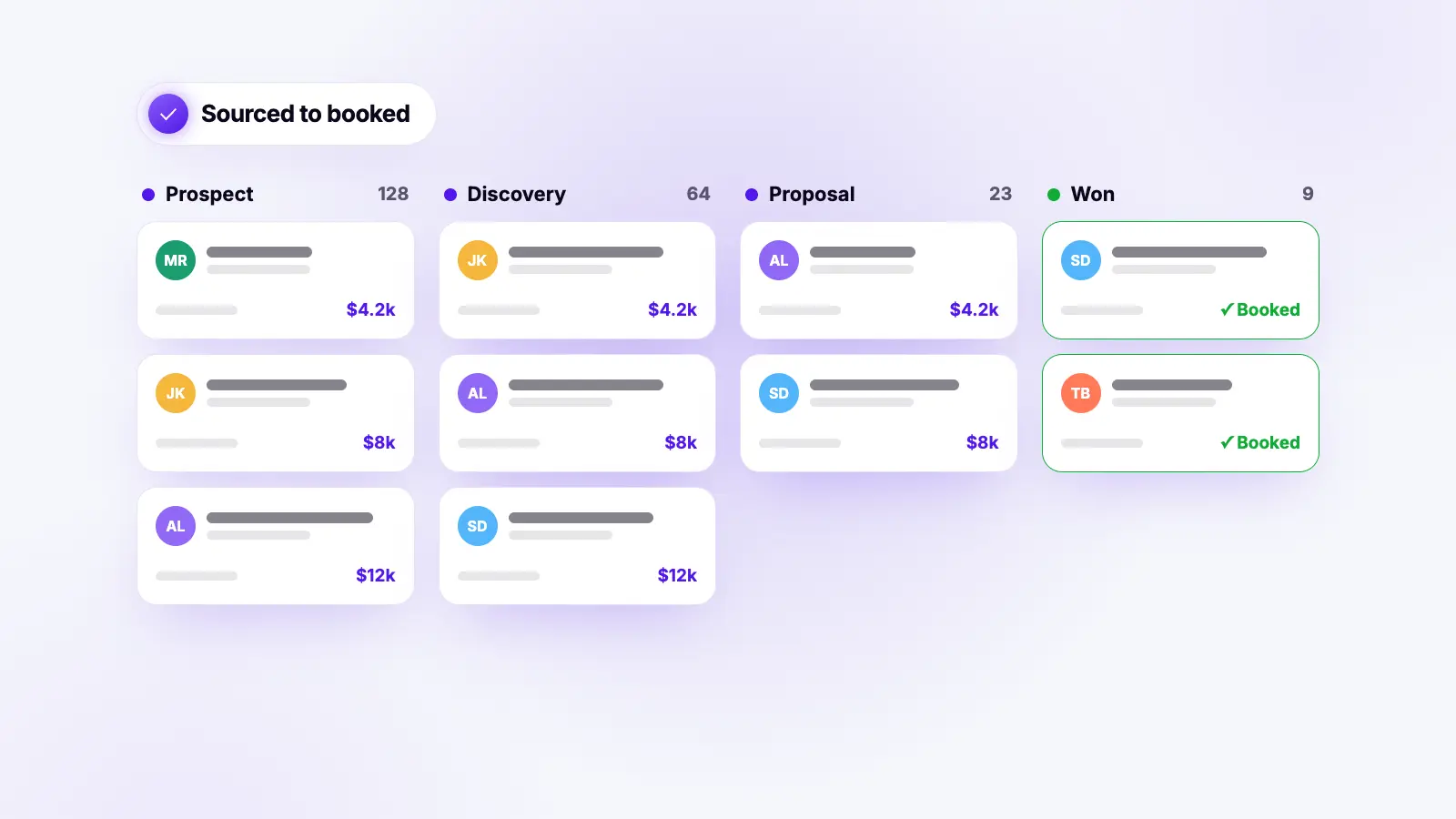
| 1 | ICP and Targeting | 7 | A graded, tiered account list |
| 2 | Prospecting and Outreach | 8 | Booked first meetings |
| 3 | Qualification | 7 | A scored opportunity, or a clean disqualification |
| 4 | Discovery | 7 | A named problem with a cost attached |
| 5 | Demo and Evaluation | 6 | A validated fit and a mapped committee |
| 6 | Proposal and Close | 8 | Signature, or a documented loss reason |
| 7 | Onboarding and Expansion | 7 | Renewal and expansion revenue |
Stage 3 producing a clean disqualification is a success, not a failure. Most pipeline problems are actually stage 3 problems that surfaced at stage 6.
Install the library
mkdir -p .agents
mkdir -p output
# Stage 1: ICP and Targeting
mkdir -p .claude/skills/{icp-from-closed-won,account-tiering,lead-scoring-model,inbound-lead-qualifier,tam-sanity-check,disqualifier-writer,decision-maker-mapper}
# Stage 2: Prospecting and Outreach
mkdir -p .claude/skills/{prospect-research,signal-based-targeting,cold-email-sequence,cold-call-opener,linkedin-outreach,cadence-designer,handoff-detection,outreach-diagnostic}
# Stage 3: Qualification
mkdir -p .claude/skills/{sales-methodology-implementer,meddic-call-prep,bant-qualifier,disqualification-check,buying-committee-mapper,champion-identifier,deal-review-framework}
# Stage 4: Discovery
mkdir -p .claude/skills/{discovery-question-designer,asking-effective-questions,active-listening-coach,pain-quantifier,current-vs-future-state,call-notes-extractor,discovery-gap-check}
# Stage 5: Demo and Evaluation
mkdir -p .claude/skills/{demo-script-builder,demo-personalizer,technical-validation,poc-scoper,competitor-battlecard,competitor-alternatives}
# Stage 6: Proposal and Close
mkdir -p .claude/skills/{proposal-writer,pricing-negotiation,zopa-mapper,objection-handler,multi-threading-planner,closing-plan,deal-momentum-analyzer,win-loss-analysis}
# Stage 7: Onboarding and Expansion
mkdir -p .claude/skills/{onboarding-plan,first-value-tracker,qbr-builder,health-score-model,renewal-predictor,expansion-revenue-finder,referral-request}
50 folders. Paste each file from the stage pages.
Repos worth pulling from
Some of these skills exist in public form already. Where they do, fork rather than write from scratch.
# 20 core sales skills: listening, rapport, discovery, objection
# handling, negotiation, closing, storytelling
npx add-skill louisblythe/salesskills
# Install only what you need
npx add-skill louisblythe/salesskills \
--skill pricing-negotiation competitor-alternatives
# List what is in it
npx add-skill louisblythe/salesskills --list
| Repo | What to take from it |
|---|---|
| louisblythe/Sales-Skills | 20 core skills. handoff-detection and asking-effective-questions are the two you will not find elsewhere. |
| OneWave-AI/claude-skills | 200+ skills. The sales set includes renewal-predictor, expansion-revenue-finder, pipeline-health-analyzer, deal-momentum-analyzer, sales-forecast-builder, sales-methodology-implementer, lead-scoring-model, inbound-lead-qualifier. |
| zubair-trabzada/ai-sales-team-claude | 14 skills, 5 parallel agents. /sales prospect fans out across five agents at once. Worth reading for the parallel pattern. |
| ScientiaCapital/skills | meddic-call-prep-auto pulls prep straight from CRM plus enrichment data. prospect-research-to-cadence chains research into sequence. |
| LeadMagic/gtm-skills | 205 GTM skills. The battlecard-builder uses the FIA framework: Fact, Impact, Act. |
| TheCraigHewitt/skills | 21 skills covering the whole B2B lifecycle. The sales-context pattern above is theirs and it is the most important thing to copy. |
| firatcand/founder-skills | Founder-led sales specifically: account tiering, cadence design, signal-based selling. |
| SimonTheSalesBooster/ClaudeSkills-SprintClub | Enterprise deal work: ZOPA mapping, buying committee, multi-threading, procurement negotiation. |
| coreyhaines31/marketingskills | The sales-enablement skill. MIT and actively maintained, so the safest to build on. |
Check licences before commercial reuse. MIT is fine, some are MIT with Commons Clause.
The rule that makes forked skills useful
A forked skill with generic objections in it is worse than no skill, because it produces confident answers to objections nobody raised.
Five things to replace in anything you fork:
- The objections. Swap the generic ten for your actual five to ten.
- The sequences. Not templates. Your top-performing subject lines and openers.
- The competitive positioning. Fill the battlecard with your real competitor data, including where they are better.
- The qualification framework. Whichever one your team actually uses, not the one the repo assumed.
- The context file.
.agents/sales-context.mdis the one that every other skill reads automatically.
The gotchas pattern is worth adopting too. A line like "never mention pricing in the first email" belongs in the skill file rather than in a rep's memory.
Section 2Stages 1 and 2: Targeting and Outreach (15 Skills)
15 skills across two stages. Stage 1 produces a tiered account list. Stage 2 turns it into booked meetings.
All fifteen read .agents/sales-context.md first.
Stage 1: ICP and Targeting, 7 skills
---
name: icp-from-closed-won
description: Derive an ICP from closed-won deals rather than
assumption. Use before any targeting or list building.
---
Pull closed-won deals, last 12 months. Per deal: company size,
industry, tech stack if visible, buyer job title, deal size, days to
close, and the trigger that started it.
Output:
1. Three attributes correlating with fast closes
2. Three correlating with long or lost deals
3. Exact job titles that actually signed, not the ones we target
4. Size band with the highest win rate
5. The searchable filter string
6. The gap between the stated ICP and the actual one
Write back into .agents/sales-context.md.
Fewer than 10 closed-won deals means say so. Do not derive a pattern
from three customers and present it as one.
---
name: account-tiering
description: Split a target list into tiers with different treatment.
Use after the ICP exists, before any outreach.
---
Three tiers, and the treatment differs per tier:
TIER 1 Exact ICP match, high deal size potential, observable
trigger. One-to-one treatment: custom research, personalised
first touch, multi-threaded from the start.
TIER 2 ICP match, no current trigger. One-to-few: segment-level
personalisation, standard sequence.
TIER 3 Adjacent fit. One-to-many: no research, template sequence,
contact only when capacity allows.
Output the count per tier and the effort budget per tier.
If tier 1 is more than 20% of the list, the criteria are too loose.
Tier 1 should be small enough to research each account by hand.
---
name: lead-scoring-model
description: Build a lead score from historical win and loss data
rather than from opinion.
---
Read closed-won and closed-lost from the CRM.
For each candidate attribute, calculate the win rate of deals that
had it against deals that did not. Keep only attributes where the
difference is meaningful across at least 10 deals each side.
Output:
- The scoring attributes, with weights derived from the win rate
difference
- The threshold above which a lead is sales-ready
- The attributes people assume matter that the data does not support
The last line is the useful one. Most scoring models encode
assumptions rather than evidence.
If the data will not support a model, say so and recommend a simple
ICP-fit binary instead of a false score.
---
name: inbound-lead-qualifier
description: Score an inbound lead by ICP fit, intent and urgency
within minutes of arrival.
---
Three axes, 1 to 3 each. Multiply. Maximum 27.
FIT Against the ICP in sales-context
INTENT What they did. Pricing page, demo request, content
download, newsletter signup.
URGENCY Anything time-bound in what they said or did
18+ Route to sales today
9-17 Nurture, revisit in 30 days
Below Nurture only, no sales contact
Output the score, the reasoning per axis, and the routing.
A demo request from outside the ICP is a 3 on intent and a 1 on fit.
That is a 9 at best, and routing it to sales wastes a slot.
The remaining three:
tam-sanity-checkโ estimates the addressable count and does the send maths. Under four weeks of sending means the ICP is too narrow for a campaign.disqualifier-writerโ the explicit list of who this is not for, which is what the filters filter ondecision-maker-mapperโ economic buyer, champion, blocker, technical evaluator, with confidence stated per assignment. UNKNOWN rather than the nearest title.
Stage 2: Prospecting and Outreach, 8 skills
---
name: signal-based-targeting
description: Find a dated, verifiable reason to contact each account
now rather than later.
---
One signal per account, ranked by proximity to a budget decision.
TIER 1, budget is already moving
- Hiring for the role our offer replaces or supports
- Raised in the last 90 days
- New leader in post, last 60 days
- Publicly named the exact problem, last 30 days
TIER 2, the problem is visible
- Site or content shows the specific gap
- Commented on a competitor's post
- Expanding into a new market or location
- Competitor of an existing customer
TIER 3, fit only, no observable trigger
Every signal verifiable and dated. Record the date and the URL,
because it appears in the first message and they will check.
A new leader in post is the strongest services signal there is. They
have ninety days to show a change and no loyalty to the incumbent.
No signal means write NONE. Never stretch an attribute into a
trigger.
---
name: cold-email-sequence
description: Write a multi-touch cold email sequence from a signal.
Use after signal-based-targeting.
---
Five touches maximum, each a different angle.
STRUCTURE per email: subject under 45 characters, body under 120
words, one ask.
SEQUENCE SHAPE
Day 1 The signal, and one question about it
Day 3 A specific observation they have not seen
Day 7 Social proof, from sales-context proof only
Day 14 Three ideas, no ask
Day 21 The close-out. "Should I close the file?"
RULES
- Plain text. No images, no HTML, no signature block with six links.
- Never mention pricing in email one.
- One ask per email, answerable in under ten words.
- Every touch references something the previous did not.
- No em dashes.
The day 21 close-out outperforms the two before it combined, because
permission to say no removes the pressure that was stopping them
replying.
BANNED, burnt:
"I hope this email finds you well"
"I'm reaching out because"
"Just following up"
"Circling back"
---
name: cold-call-opener
description: Write the first 15 seconds of a cold call, plus
gatekeeper and voicemail variants.
---
THE OPENER, 15 seconds maximum
- Name, company, and the reason in one sentence
- Permission question: "Did I catch you at a bad time?"
- Then the signal, specific and dated
The permission question is counterintuitive and it works, because it
gives them an easy out and most people do not take it.
GATEKEEPER
Be honest about who you are and why. Ask for the person by name and
role. Never claim a prior relationship you do not have.
VOICEMAIL, under 20 seconds
- Name, one sentence on the reason, a number, and stop
- No pitch. A voicemail that pitches gets deleted at the pitch.
OBJECTION AT THE DOOR
"Not interested" before you have said anything is a reflex, not an
objection. One question, then let them go.
Output the opener, the two variants, and the three most likely
responses with a next line for each.
---
name: handoff-detection
description: Decide when an automated or AI-assisted thread needs a
human. Use on every inbound reply in a sequenced conversation.
---
HAND OFF IMMEDIATELY WHEN
- They ask something requiring a commitment on price, scope or
timeline
- They mention a contract, procurement, legal or security review
- They express frustration, however mildly
- They reference a previous conversation you have no record of
- They ask a direct question about a competitor
- Confidence in the classification is below 8 out of 10
CONTINUE AUTOMATED WHEN
- They asked for information that exists and is uncontroversial
- They asked for a time or a link
- They replied out of office
Output: HANDOFF or CONTINUE, the trigger, and the confidence.
Default to HANDOFF. A human reading a thread that did not need them
costs two minutes. An automated reply to a procurement question costs
the deal.
The remaining four:
prospect-researchโ fans out across site, content, hiring and reviews in parallel, then synthesises one brief. Never asserts a metric about their business.linkedin-outreachโ connection requests, InMails and DM sequences. Under 300 characters, one ask, signal in line one.cadence-designerโ decides when to email, call, message or send something physical, and in what order per tieroutreach-diagnosticโ works the chain in order and stops at the first failure. Reply rate below 10% with healthy deliverability means the first message, not the list.
Where the LinkedIn half runs
linkedin-outreach and cadence-designer produce a spec. The spec has to run somewhere, and it should not be a browser session on your own account.
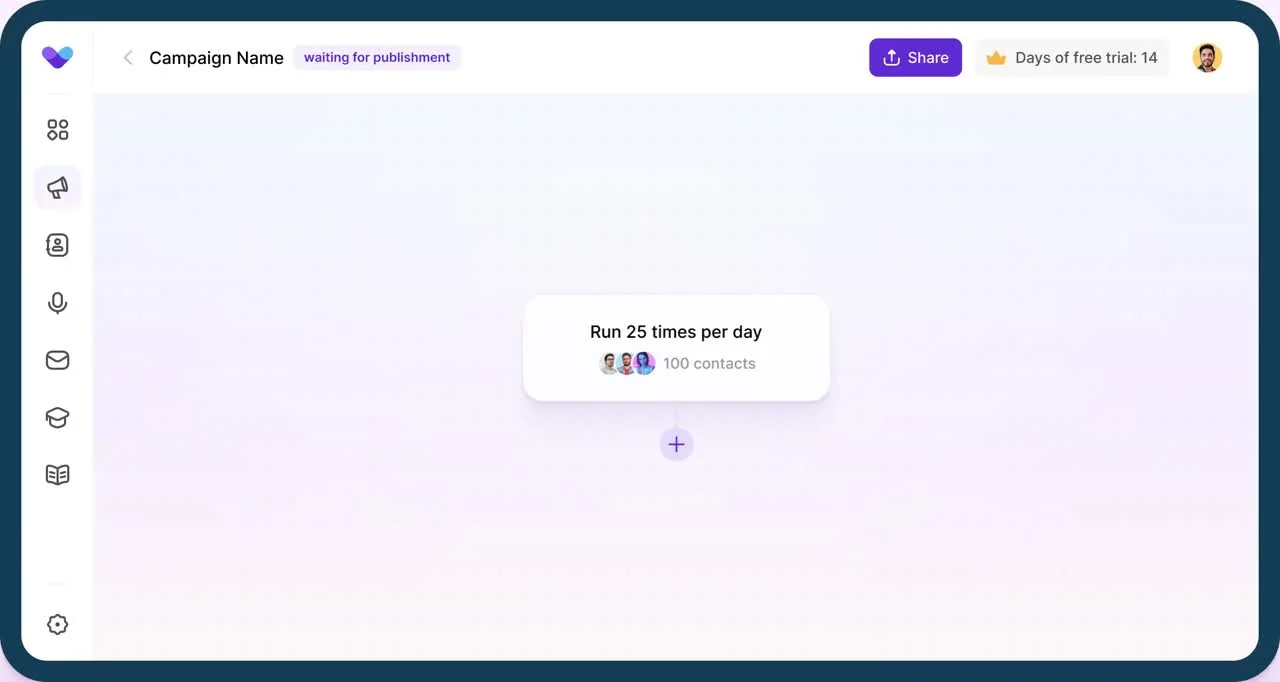
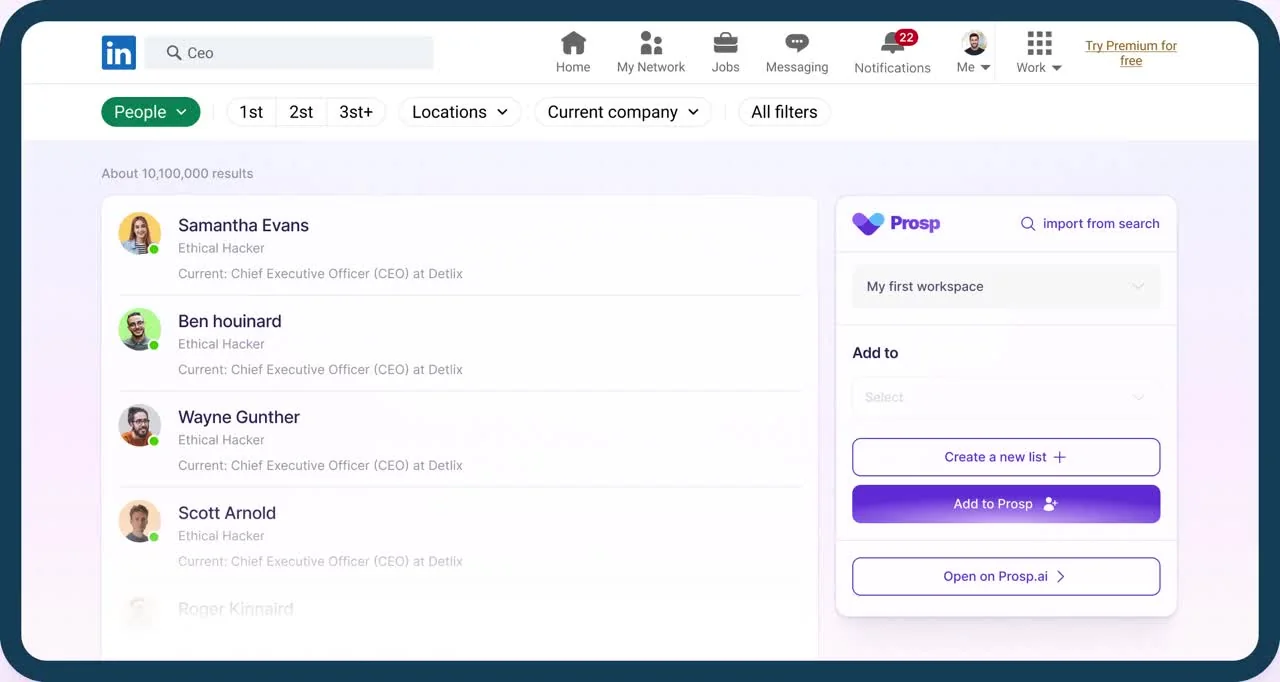
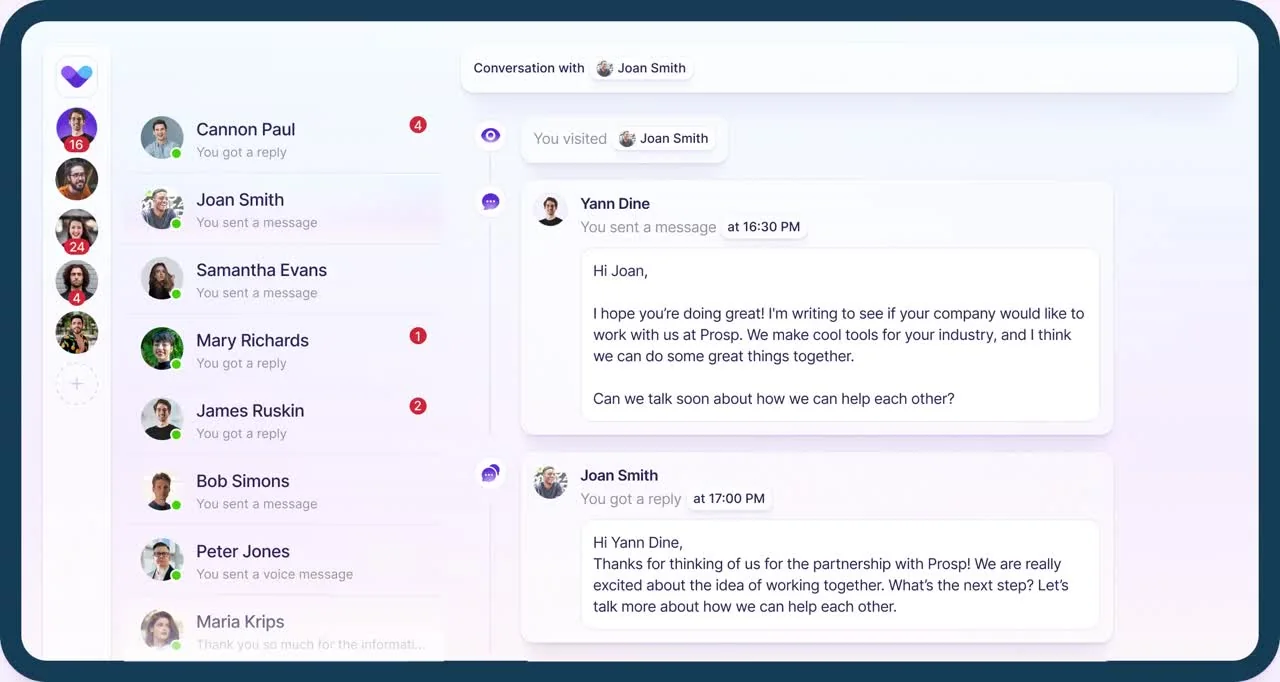
Prosp runs that layer: cloud-based so nothing depends on a machine staying awake, a free dedicated residential proxy per connected account, and activity paced under the platform's thresholds. Setup is about five minutes, free trial, no card.
The constraint to design the cadence around: 20 connection requests a day and roughly 100 messages a week, account-wide rather than per campaign. Three campaigns at 20 each means 60 attempts a day and a restricted account.
That ceiling is why account-tiering exists. Tier 1 gets the sends, tier 3 gets whatever is left, and getting that order wrong wastes a quarter.
Section 3Stages 3 to 5: Qualification, Discovery, Demo (20 Skills)
20 skills across three stages. Qualification decides whether the deal is real. Discovery finds the problem. Demo proves the fit.
Most pipeline problems are stage 3 problems that surfaced at stage 6, which is why disqualification is treated as a success here.
Stage 3: Qualification, 7 skills
---
name: sales-methodology-implementer
description: Apply the team's chosen framework consistently. Use on
every opportunity at qualification.
---
Read which framework sales-context specifies. Do not substitute one.
MEDDIC Metrics, Economic buyer, Decision criteria, Decision
process, Identify pain, Champion
MEDDPICC The above plus Paper process and Competition
BANT Budget, Authority, Need, Timeline
SPIN Situation, Problem, Implication, Need-payoff
CHALLENGER Teach, Tailor, Take control
PER ELEMENT output: what we know, the evidence, and confidence 1 to
10. Anything below 6 is a gap, not a fact.
Then the two gaps that most change the forecast, and the question
that closes each.
NEVER fill an element by inference. "They probably have budget
because they are a Series B" is not a budget answer. Write UNKNOWN.
A deal with four UNKNOWNs is not a late-stage deal regardless of how
long it has been open.
---
name: meddic-call-prep
description: Generate call prep from CRM and enrichment data before a
qualification call.
---
Pull the account record, the contact record, and any enrichment.
Output one page:
WHAT WE KNOW
Per MEDDIC element, what the record already contains, with the source.
WHAT WE DO NOT KNOW, ranked
The five gaps that would most change the recommendation. Ranked by
how much they change it. These are the questions.
THE FIVE QUESTIONS
One per gap. Open, short, answerable without preparation.
Never ask something the record already answers. That signals nobody
read it.
WHO ELSE
What to ask to surface the other decision makers without making it
obvious you are asking.
LIKELY OBJECTIONS
Two, based on their size and sector, from the objections list in
sales-context. With the honest answer, not a rebuttal.
DISQUALIFIERS
What would make this a bad deal. If you hear these, say so on the
call rather than progressing it.
Under one page. A brief you cannot read in three minutes will not be
read.
---
name: disqualification-check
description: Actively look for reasons to kill a deal. Run at
qualification and again before any proposal.
---
This skill exists because nobody else in the process is incentivised
to do it.
CHECK
- Do they hit any disqualifier in sales-context
- Is there an economic buyer identified, or just a champion
- Is there a compelling event with a date, or only interest
- Can they afford the entry price
- Is there an incumbent with a contract that has not been checked
- Has anything moved in the last 14 days
Output one of:
QUALIFIED All checks pass. State the compelling event.
AT RISK Named gaps, with the question that resolves each.
DISQUALIFY The specific reason, and the honest message to send.
A clean DISQUALIFY is a success. It returns send capacity, calendar
time and forecast accuracy.
Never soften a DISQUALIFY into AT RISK because the pipeline looks
thin. That is how a quarter gets missed twice.
---
name: buying-committee-mapper
description: Map everyone who can say no. Use as soon as a second
person appears in the thread.
---
FOUR ROLES, and every deal has all four whether you have found them
or not:
ECONOMIC BUYER Owns the budget line. Can say yes alone.
CHAMPION Feels the problem daily. Cannot say yes alone.
BLOCKER Whose remit the change touches. Can say no alone.
TECHNICAL EVALUATOR If the offer needs validation.
PER PERSON: name, title, LinkedIn URL, the role they play, our
current relationship, and confidence in the role assignment.
UNKNOWN is a valid and important answer. A deal with an unidentified
economic buyer is single-threaded regardless of how many people are
on the thread.
Output the coverage gaps and one action per gap.
The blocker is the role most often missed, because they are not in
the conversation until they kill it.
The remaining three:
bant-qualifierโ the lighter framework for shorter cycles, with the same UNKNOWN disciplinechampion-identifierโ tests whether your contact is actually a champion or just friendly. A champion will take a risk for you; a friendly contact will not.deal-review-frameworkโ MEDDIC or BANT assessment with a risk score, run in pipeline review rather than by the rep on their own deal
Stage 4: Discovery, 7 skills
---
name: discovery-question-designer
description: Build discovery questions for a specific deal size and
complexity. Use before the call, not during.
---
Organise by topic, never as a script. A script gets read; topics get
asked.
FOUR TOPICS, questions per topic:
1. Current state. What happens today, step by step.
2. The problem. What breaks, how often, who notices.
3. Implication. What it costs, and what happens if nothing changes.
4. Desired state. What good looks like, in their words.
RULES
- Open questions only. Anything answerable yes or no belongs in
qualification, not discovery.
- One question at a time. Two gets you an answer to the easier one.
- Never ask something the research already answered.
- Never ask a question whose answer you would not act on.
STOP RULE
If you cannot state their problem in their own words at the end of
the call, discovery is not finished, regardless of how long the call
ran.
Output 12 to 15 questions across the four topics, and the three you
must get answered.
---
name: pain-quantifier
description: Attach a number to the problem, using their arithmetic.
Use during or straight after discovery.
---
A problem without a cost is a preference. A cost they calculated
themselves is a business case.
WALK IT THROUGH WITH THEM
1. How often does this happen? Per week, per month.
2. How many people are involved each time?
3. How long does it take them?
4. What is that in loaded cost, or in delayed revenue?
5. What does that annualise to?
Use THEIR numbers at every step. If they do not know one, ask for
their estimate and label it as an estimate in the output.
OUTPUT
The arithmetic, shown, with the source of each input and whether it
was measured or estimated.
NEVER supply a number they did not. Never use an industry benchmark
in place of their figure. A business case built on your assumptions
collapses the first time their CFO checks it.
If the quantified cost is smaller than your price, say so. That is
not a deal, and finding out now is worth more than finding out at
proposal.
---
name: current-vs-future-state
description: Turn discovery into a two-column picture the buyer can
circulate internally.
---
TWO COLUMNS, same rows.
PER ROW: the process step, what happens today, what happens after.
RULES
- Today's column uses their words and their steps. If you invented a
step they did not describe, cut it.
- The after column contains only what we can actually deliver.
- Every row carries the same unit. If today is measured in days,
after is measured in days.
- No row where the after column is aspirational rather than
deliverable.
This document is the one the champion forwards to the economic buyer.
Write it so it survives being read by someone who was not on the
call.
End with the one row that matters most to them, named.
The remaining four:
asking-effective-questionsโ the technique layer: open versus closed, the follow-up that gets the real answer, and the silence afteractive-listening-coachโ reviews a transcript for talk ratio, interruptions, and questions asked versus statements madecall-notes-extractorโ pulls decisions, action items, open questions and quoted problems from a transcript. The verbatim quotes matter most, since every later document reads better with them.discovery-gap-checkโ run before booking the demo. If you cannot state their problem in their words, the demo will be a feature tour.
Stage 5: Demo and Evaluation, 6 skills
---
name: demo-personalizer
description: Build a demo around the buyer's stated problem rather
than the product tour. Use after discovery, never before.
---
Read the discovery notes and the quantified pain.
STRUCTURE
1. Restate their problem in their words. Get agreement before
showing anything.
2. Show the one thing that addresses it. Nothing else yet.
3. Pause. Ask whether that solves the thing they described.
4. Then the two adjacent capabilities that matter to their case.
5. Stop. Everything else is a follow-up call.
RULES
- Never demo a feature they did not raise a need for.
- Never demo in the order the product menu is in.
- Three capabilities maximum. A four-feature demo is a tour.
- If discovery did not produce a stated problem, do not demo. Book
another discovery call instead.
Output the flow, the exact restatement line, and the two questions to
ask mid-demo.
A demo that shows everything proves nothing.
---
name: competitor-battlecard
description: Build a battlecard using the FIA framework. Use per
named competitor, refreshed quarterly.
---
FIA, per competitor:
FACT Something verifiable and dated about them. Not opinion.
IMPACT What that means for this buyer specifically.
ACT What we say, and when in the conversation to say it.
COVER
- Where they genuinely win. Name it honestly.
- Where we win, with the evidence
- The trap question that surfaces the difference without naming them
- What to say when the buyer raises them unprompted
- What never to say
RULES
- Every FACT needs a source and a date. A stale battlecard loses
deals faster than no battlecard.
- Never characterise their team, their pricing motive or their
roadmap.
- The "where they win" section is mandatory. A battlecard we win on
every row reads as marketing and gets discounted entirely.
Output one card per competitor, and the single strongest
differentiator across all of them.
The remaining four:
demo-script-builderโ the reusable base script, with talking points mapped to buyer role rather than to featuretechnical-validationโ gap analysis, feature matrix, and the honest list of what we do not dopoc-scoperโ success criteria agreed in writing before the POC starts, with a date. A POC with no exit criteria never ends.competitor-alternativesโ handles "we are also looking at X" and "we already use X" as two different conversations, because they are
Section 4Stages 6 and 7: Close, Onboarding, Expansion (15 Skills)
15 skills across two stages. Stage 6 closes or documents the loss. Stage 7 is where the revenue actually compounds and where most teams have nobody.
Stage 6: Proposal and Close, 8 skills
---
name: proposal-writer
description: Write a proposal from call notes. Same day as the call,
always.
---
ASK, in one message, for anything missing:
1. The problem in their words. Quote them literally.
2. What they have already tried, and why it failed
3. Deliverables agreed on the call
4. Price to quote
5. Budget signal: named a figure / gave a range / dodged it / no
budget yet
6. Anything that would kill this deal
FOUR SECTIONS
1 DIAGNOSIS
Their problem in their own phrasing, not a paraphrase. Then the
underlying cause using why the last attempt failed. Then the cost
of leaving it, from pain-quantifier.
2 APPROACH
Phased. Per phase: what we do, what they receive as an object,
roughly when. Phase one addresses why the last attempt failed.
One line naming what we do NOT do.
3 SCOPE AND INVESTMENT
Branch on the budget signal:
named a figure -> ONE option at that price. Three tiers signals
you were not listening.
gave a range -> TWO options, the quote and a 70% reduced scope.
Name what comes out.
dodged it -> THREE tiers at roughly 70%, 100%, 140%. The
tiers do the qualifying.
no budget yet -> ONE option plus a paid discovery at ~15%.
State what the price excludes, payment terms, notice period.
4 WHAT COULD GO WRONG
Two or three real risks, starting with the deal-killer they named.
Each with what we do about it. "This takes time" is a disclaimer,
not a risk.
RULES
- Timeline in week ranges, never dates. Dates go stale if it is not
signed that week.
- Never invent a number, client name or result.
- Never discount unprompted.
- No em dashes.
FAIL CLOSED IF the problem was not captured verbatim, or no budget
signal was recorded. The section 3 branch cannot be chosen without it.
---
name: zopa-mapper
description: Map the zone of possible agreement before a negotiation.
Use before the call, never during.
---
FOUR NUMBERS, established before you speak to them:
OUR WALK-AWAY The point below which we decline. Set it now, in
writing, before any pressure exists.
OUR TARGET What we open at and why that is defensible.
THEIR CEILING Estimated, with the evidence. Budget signals,
comparable spend, what they said.
THEIR WALK-AWAY What they lose by not doing this, from
pain-quantifier.
The ZOPA is between our walk-away and their ceiling. If those do not
overlap, there is no deal and the negotiation is theatre.
THEN, per concession we might make:
- What it costs us
- What we ask for in return. Never concede unilaterally.
- Whether it is reversible
TRADE LIST, ranked by what costs us least and reads as most valuable
to them: timeline, payment terms, scope, term length, support tier,
logo rights, case study participation.
Price is the last thing to move, and only for term length or
prepayment.
---
name: objection-handler
description: Draft a response to a specific objection. Use when the
objection is named, not when the deal is quiet.
---
Read the objections list in sales-context first. If it is on the
list, use the agreed response rather than inventing one.
NAME IT PRECISELY before answering. "Not interested" is not an
objection, it is an absence of one. Ask what is behind it.
THREE MOVES
1. Agree with the part that is true. There always is one.
2. Add the thing they do not know. One fact, not three.
3. Ask a question that moves it forward or closes it out.
RULES
- One objection per message. Pick the real one.
- Never answer a price objection with features. Ask what it is being
compared against.
- "We already use [competitor]" is information, not rejection. Ask
what it does not do.
- If they say no twice, stop. Thank them and leave the door open.
Never invent a number, customer or comparison to answer an objection.
If the honest answer is "we are not a fit for that", say it. That
reply gets referrals; a stretched one gets a bad implementation.
---
name: multi-threading-planner
description: Build relationships beyond the champion. Use as soon as
the deal passes qualification.
---
A single-threaded deal dies when one person changes job, and roughly
one in five will during a long cycle.
PER ROLE from buying-committee-mapper, output:
- Current relationship: none, aware, engaged, advocate
- The specific reason to contact them that serves them, not us
- The route in: champion introduction, direct, event, content
- What they need to hear that the champion does not
RULES
- Never go around the champion without telling them. Ask them to
introduce you.
- Each thread needs its own reason to exist. "Touching base" burns
the relationship you just opened.
- The economic buyer gets the business case, not the demo.
- The blocker gets the risk mitigation, not the benefits.
Output the coverage map and the next action per uncovered role.
A deal with three engaged threads forecasts differently from one with
one, and should be scored differently.
The remaining four:
pricing-negotiationโ the tactical layer on top ofzopa-mapper. Never the first concession, never a discount without a trade.closing-planโ the mutual action plan with dates, working backwards from their compelling event. Shared with the buyer, not kept internal.deal-momentum-analyzerโ scores velocity from engagement patterns. Days since last inbound contact is the single best stall predictor.win-loss-analysisโ run on both. The losses are worth more, and the question is what they chose instead and why, not whether price was a factor.
Stage 7: Onboarding and Expansion, 7 skills
The stage most teams have nobody on, and the one where the revenue actually is.
---
name: onboarding-plan
description: Build the first 30 days from the promises made in the
sale. Use the day the contract is signed.
---
Read the proposal and the discovery notes. The plan must deliver what
was sold, not what is easy to deliver.
STRUCTURE
Week 1 Access, data, and the single first outcome. Name it.
Week 2 The first real use by a real user, not a demo account
Week 3 The second use case from the proposal
Week 4 Review against the proposal's phase one, in writing
PER WEEK: what we do, what they do, and the named owner on each side.
A plan with no owner on their side does not happen.
DEFINE FIRST VALUE explicitly. One sentence: the moment they get
something they could not get before. Everything in week 1 serves it.
FLAG any promise in the proposal that onboarding cannot deliver in
phase one. Raise it now, internally, rather than at the week 4
review.
---
name: health-score-model
description: Build an account health score from signals that actually
predict churn, not from activity.
---
Start from churned accounts, not from opinion. For each, look back 90
days before they left and find what was observably different.
CANDIDATE SIGNALS
- Usage trend, not usage level. A declining heavy user is at more
risk than a stable light one.
- Number of active users versus licensed
- Champion still in post
- Support ticket sentiment, not volume
- Days since last inbound contact from them
- Whether the original use case is still being used
Keep only signals where churned and retained accounts differed
meaningfully across at least 10 accounts each side.
Output the score, the threshold for intervention, and the signals
people assume matter that the data does not support.
Champion departure is usually the strongest single predictor and the
one least often tracked.
---
name: expansion-revenue-finder
description: Find upsell and cross-sell in existing accounts. Run
monthly across the book.
---
FOUR ROUTES, in order of how easy they are to close:
1 SEAT EXPANSION
Licensed versus active users. A team at 100% utilisation is at
capacity, not fully served.
2 USE CASE EXPANSION
The second problem from the original discovery notes that never
got addressed. It is already documented and already agreed.
3 DEPARTMENT EXPANSION
An adjacent team with the same problem. The champion is the route.
4 TIER UPGRADE
Only where they are hitting a real limit. Never pitch a tier for
features they have not asked for.
PER OPPORTUNITY: the route, the evidence, the champion, and the
reason it serves them rather than us.
RULES
- Never pitch expansion to an account below the health threshold.
Fix retention first.
- Route 2 is the highest-converting and the least used, because it
requires reading the original discovery notes.
- An expansion conversation in month two is premature regardless of
the opportunity.
The remaining four:
first-value-trackerโ measures time to first value against the definition set in onboarding. The single best leading indicator of renewal.qbr-builderโ the review that reports against the proposal's promises rather than against activity. Every metric pairs with a decision.renewal-predictorโ renewal likelihood from health signals, run 120 days out so there is time to actreferral-requestโ asked at first value, not at renewal. The moment they get the outcome is the moment they will introduce you.
The two stages that decide the year
Stage 3 and stage 7, and both are underweighted in most teams.
Stage 3. disqualification-check exists because nobody else in the process is incentivised to kill a deal. A rep with a thin pipeline will not disqualify, and a manager reviewing 40 deals cannot. The skill is the only impartial party.
Stage 7. expansion-revenue-finder route 2 is the cheapest revenue available anywhere in the cycle: the second problem from the original discovery notes, already documented, already agreed, and nobody ever goes back for it.
If you install only ten of the fifty, take: icp-from-closed-won, signal-based-targeting, sales-methodology-implementer, disqualification-check, discovery-question-designer, pain-quantifier, demo-personalizer, proposal-writer, zopa-mapper, expansion-revenue-finder.
Feeding the top of the cycle
Fifty skills produce documents. None of them contacts anyone.
Stage 2's linkedin-outreach and cadence-designer output a spec, and Prosp runs it. Cloud-based so nothing depends on a session staying open, a free dedicated residential proxy per connected account, and activity paced under the platform's thresholds. Free trial, no card, about five minutes to set up.
The ceiling that should shape account-tiering: 20 connection requests a day and roughly 100 messages a week, account-wide rather than per campaign. That is what makes tier 1 needing to be small a maths problem rather than a preference.
For the reporting side, stages 2 and 6 both need data LinkedIn does not export usefully. Prosp pushes to HubSpot natively, plus 12 webhook events including Message Replied and Connection Accepted, and a REST API at prosp.ai/api/v1/leads, so outreach-diagnostic and deal-momentum-analyzer run on real figures.
50 skills run the cycle. Prosp fills the top of it ๐
โณ Start a 14 Day Free Trial ๐ โณ Watch Full Tutorial โถ๏ธ