


Section 1What Google Released and Why It Matters for GTM Engineers
Sources:
- YouTube: "Google Just Changed Everything" (Nick Ponte, Gemini Spark, Omni, Avatars, Daily Brief, 3.6 Flash overview)
- YouTube: "Gemini 3.6 Flash and 3.5 Flash Light: First Look" (Google AI Studio, Anti-Gravity IDE, live benchmark testing)
- YouTube: "Gemini 3.6 Flash Full Test" (Anti-Gravity IDE deep testing: coding, 3D models, Android app build, front-end design)
- GitHub: google-gemini/gemini-skills (3 official skills: gemini-api-dev, gemini-live-api-dev, gemini-interactions-api)
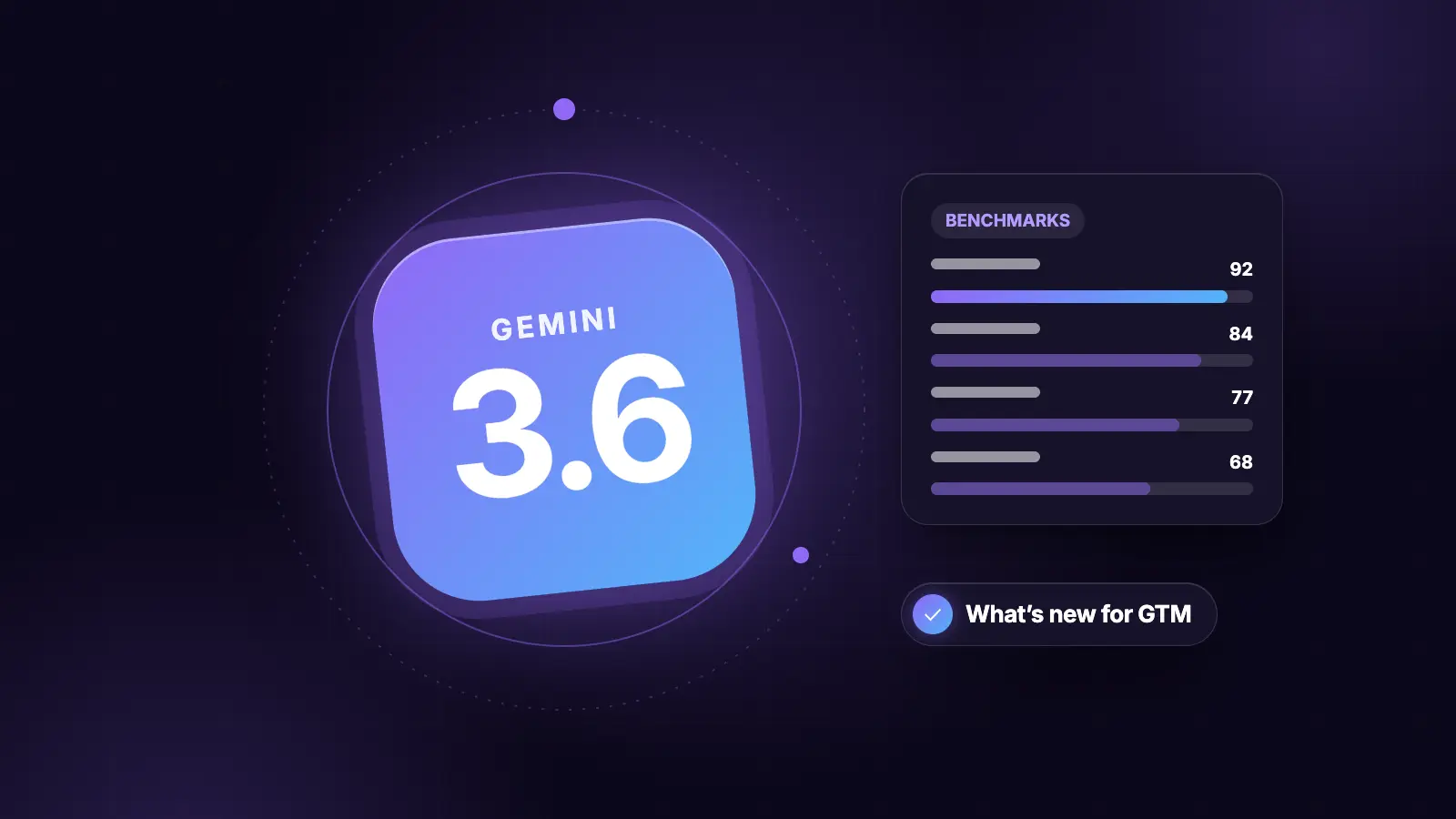
Google dropped a full restructuring of its AI stack in one week in July 2026. The company is done with the chatbot model. Everything it released is oriented toward agents that take action rather than assistants that answer questions. For GTM engineers already running Claude Code and agentic workflows, this is the Google-native equivalent of the same shift.
This playbook covers:
- The 5 new tools and what each one actually does (not the marketing version)
- Gemini 3.6 Flash and 3.5 Flash Light: the new model tier and where each fits
- The 3 official Gemini skills from google-gemini/gemini-skills and the Gemini API MCP
- GTM-specific use cases for each tool
- Where most people will get this wrong
The one-week Google drop: what released and when
| Tool | What it is | Status |
|---|---|---|
| Gemini 3.6 Flash | New flagship flash model for agentic and multimodal tasks | Live in Google AI Studio, rolling out to Gemini app |
| Gemini 3.5 Flash Light | Fastest, cheapest model for high-volume production | Live in Google AI Studio |
| Gemini 3.5 Flash Cyber | Security-focused model, fine-tuned for vulnerability finding and patching | Limited access pilot only, trusted parties |
| Gemini Omni | Conversational video generation and editing model | Live in Gemini app and YouTube Shorts |
| Gemini Spark | Always-on personal AI agent running on Google's servers | Testing with small group, wider rollout coming |
| Gemini Avatars | Digital twin creation from face and voice scan | Rolling out with age verification and watermarking |
| Gemini Notebook (rebranded) | Notebook LM with code execution, collections, and cross-app sync | Code execution live for Ultra/Workspace, rolling out to Pro |
| Daily Brief | Morning AI summary of email, calendar, and tasks | Live in Gemini app |
Section 2Gemini 3.6 Flash and 3.5 Flash Light: Model Breakdown
Sources: Google AI Studio, Anti-Gravity IDE testing, benchmark data
The two models GTM engineers should actually care about. All other models in the drop are either restricted (Cyber) or incremental.
Gemini 3.6 Flash: the new default for agentic GTM work
API string: gemini-3.6-flash
Knowledge cutoff: March 2026 (3.5 Flash was January 2025 — a meaningful jump)
What changed vs 3.5 Flash:
- Better at agentic and multimodal tasks specifically (Google's stated focus for this model)
- 17% fewer tokens needed to complete the same task (confirmed on Artificial Analysis Index)
- Cheaper output: $7.50/MTok output vs $9/MTok on 3.5 Flash
- Input cost unchanged: $1.50/MTok
- Massive leap on DeepSWE benchmark (the benchmark the community treats as the most honest measure of coding capability)
- Improved computer use capabilities
- Better knowledge work performance
What the live testing showed (Anti-Gravity IDE):
- Strong at self-correction from visual feedback: shown a screenshot of a broken result, it identifies and fixes the issue without being told specifically what went wrong
- Adds unrequested features that make sense: in a V8 engine 3D model test, it built an interactive website with exploded view, component toggling, colour scheme changes, and STL download — none of which were asked for
- Android app deployment: built and installed a guitar tuner app with AI-generated exotic tunings, microphone input, confetti on correct tuning, directly onto a connected Android phone via ADB in a single session
- Weak spot: some web/HTML output results underperformed 3.5 Flash on the same prompts, particularly complex layouts
Speed note: when first released, Google was serving 3.6 Flash on a "fast limited time" tier that made results appear faster than even 3.5 Flash Light. This may normalise after the launch window.
Gemini 3.5 Flash Light: for high-volume, cost-sensitive GTM automation
API string: gemini-3.5-flash-light
Speed: 350 output tokens per second (verified)
Cost: $0.30/MTok input, $2.50/MTok output
This is the sub-agent model. It is the Haiku equivalent in the Gemini tier: fast, cheap, and surprisingly capable for structured tasks.
What the live testing showed: on some tests (a subway station FPS scene), Flash Light produced results that were visually comparable to 3.6 Flash at a fraction of the cost. The capability gap between tiers is smaller than the price gap.
Where to use it in GTM:
- Bulk data classification and scoring (lead scoring, signal classification)
- High-volume CRM record processing
- Sub-agent tasks inside a multi-agent GTM workflow
- Drafting that will be reviewed and edited anyway
Where not to use it:
- Complex multi-step reasoning
- Anything requiring the March 2026 knowledge cutoff
- Tasks where the output ships without human review
# Model comparison at a glance
# gemini-3.6-flash: $1.50 in / $7.50 out, March 2026 cutoff, best agentic
# gemini-3.5-flash: $1.50 in / $9.00 out, Jan 2025 cutoff (now superseded)
# gemini-3.5-flash-light: $0.30 in / $2.50 out, fast, sub-agent work
# gemini-3.5-flash-cyber: restricted access only
Where to access the new models
Google AI Studio (primary): aistudio.google.com. The new models appear in the model selector in the top right corner of the Playground. Both 3.6 Flash and 3.5 Flash Light are accessible here immediately.
Anti-Gravity IDE: Google's native coding IDE for Gemini models, comparable to Claude Code in its context and tool use capabilities. If you are building anything with the Gemini API, this is the environment to use. It runs the gemini-skills from the official repo automatically.
Gemini app: 3.6 Flash has fully rolled out as the default model in the Gemini app as of the recording dates. 3.5 Flash Light is accessible in AI Studio.
Gemini 3.5 Pro: still in testing with partners as of this drop. Not yet broadly available but confirmed as next in the pipeline.
Section 3The 3 Official Gemini Skills and the API Docs MCP
Source: github.com/google-gemini/gemini-skills (Apache 2.0, 3.5k stars, 323 forks)
Official Google skills for building Gemini-powered agents. These close the knowledge gap between what Gemini was trained on and how the API actually works today.
Performance data: adding the gemini-api-dev skill improved correct API code generation to 87% with Gemini 3 Flash and 96% with Gemini 3.1 Pro vs the baseline without the skill.
Install
# Using Vercel skills CLI
# Browse and install interactively
npx skills add google-gemini/gemini-skills --list
# Install a specific skill globally
npx skills add google-gemini/gemini-skills --skill gemini-api-dev --global
# Using Context7 skills CLI
npx ctx7 skills install /google-gemini/gemini-skills
npx ctx7 skills install /google-gemini/gemini-skills gemini-api-dev
# Install the Gemini API docs MCP server alongside the skills
npx add-mcp "https://gemini-api-docs-mcp.dev"
The MCP server adds a search_docs tool that gives your agent real-time access to current API definitions, code examples, and integration patterns from the official Gemini API docs. Install both the skill and the MCP server. They are complementary: the skill loads context when needed, the MCP server is always available for live lookups.
Skill 1: gemini-api-dev
The foundational skill for building anything with the Gemini API. Provides the current best practices for app development that the model does not know from training alone.
Why it exists: LLMs are trained at a specific point in time. The Gemini API changes frequently. New libraries, new patterns, subtle best practice shifts (like thought circulation and thought signatures) are things the model cannot know without explicit instruction. This skill bridges that gap.
What it covers:
- Correct API initialisation patterns
- Current SDK usage for both Python and TypeScript/JavaScript
- Best practices for structured output, function calling, and streaming
- Guardrails against deprecated patterns the model might default to from training data
Trigger: loads automatically when you are working in Anti-Gravity or any coding agent that has it installed, whenever Gemini API work begins.
# Install
npx skills add google-gemini/gemini-skills --skill gemini-api-dev --global
# Use in any session that involves Gemini API code
# The skill loads before the model writes any API-related code
Skill 2: gemini-live-api-dev
For building real-time, bidirectional streaming applications with the Gemini Live API.
What it covers:
- WebSocket-based audio, video, and text streaming
- Voice activity detection
- Native audio features
- Function calling in a live streaming context
- Session management for persistent connections
GTM use cases: AI-powered real-time call coaching that listens to a sales call and surfaces objection handling prompts, live transcription and CRM logging during a call, real-time qualification scoring as a prospect speaks.
npx skills add google-gemini/gemini-skills --skill gemini-live-api-dev --global
Skill 3: gemini-interactions-api
For building applications using the Gemini Interactions API: a higher-level API designed for common app patterns.
What it covers:
- Text generation and multi-turn chat
- Streaming
- Function calling and structured output
- Image generation
- Deep Research agents
- Deprecated model guardrails (prevents the model from using patterns that no longer work)
- Both Python and TypeScript SDKs
GTM use cases: building a lead research agent that runs Deep Research on a target account before an outbound call, building an image generation pipeline for on-brand ad creatives using Gemini's image model, building a structured output enrichment agent that returns clean JSON from scraped prospect data.
npx skills add google-gemini/gemini-skills --skill gemini-interactions-api --global
The Gemini API docs MCP server
Public MCP server hosted at https://gemini-api-docs-mcp.dev. Connects your coding agent to live Gemini API documentation.
What it adds: a search_docs tool that retrieves real-time API definitions and integration patterns from the official Gemini API docs. Prevents the model from using outdated patterns even when the skill file itself has not been updated.
# Install
npx add-mcp "https://gemini-api-docs-mcp.dev"
# What this unlocks in your agent:
# - Real-time API definition lookup
# - Current integration examples
# - Latest model capabilities and parameters
# - Correct function calling patterns for new models
Install both the gemini-api-dev skill and the MCP server. The skill works without the MCP, but together they cover both static best practices (skill) and live lookup (MCP).
Section 4GTM Use Cases: Spark, Omni, Avatars, Daily Brief, Notebook
Sources: YouTube transcripts. GTM-specific framing for each of the 5 new tools.
Gemini Spark: the always-on agent
What it is: a personal AI agent running on Google's servers continuously. It keeps working after you close your laptop or lock your phone. You can email it directly like emailing a colleague. It reads your messages, checks your calendar, and takes action.
Connections: email, documents, slides, and outside services including grocery delivery and restaurant booking. Testing with a small group now, wider rollout coming.
Where most people get it wrong: treating it like a fancy reminder app. Draft an email, set a note, done.
GTM use: point Spark at a business inbox or a client's inbox. Have it flag the messages that actually matter: a new lead asking about pricing, a customer about to walk away, a proposal that has gone cold. It runs while you sleep. You wake up to a prioritised list of what needs attention, not a full inbox to triage.
For GTM engineers managing multiple client accounts: Spark as a per-client inbox monitor that surfaces buying signals and escalation signals daily. The value is not in the task it completes. It is in the signal it surfaces from the noise.
Gemini Omni: video generation and editing
What it is: Google's video generation and conversational editing model. Takes text, photos, or video clips and builds a scene, then lets you keep editing it with natural language. Available in the Gemini app video section and YouTube Shorts. Every video carries an invisible digital watermark.
Capabilities confirmed in testing:
- Text prompt to video
- Photo to video (uploaded a Rolex image, produced a luxury watch ad with professional voiceover)
- Video editing via natural language ("add subtitles, don't change anything else" — executed correctly)
- AI avatar video: scan face and voice, generate a video of yourself saying anything
- Physics understanding: understands gravity and liquid movement, outputs look more realistic than older AI video
Settings in Google AI Studio: aspect ratio (16x9 or 9x16), video duration, resolution, frame rate, thinking level, system instructions.
GTM use: take one testimonial-style script and generate 10 versions for 10 different cities or niches by changing the background. Test which grabs attention before committing to production. What used to take a video editor a full day now costs one prompt and produces 5 testable variants before lunch. For agencies: the same ad creative testing workflow at a fraction of the cost.
Gemini Avatars: AI version of yourself
What it is: scan your own face and voice (read a few numbers out loud, turn your head side to side), and generate videos of yourself from a text prompt. Setup takes a few minutes. Safety requirements: 18+ age verification, watermark on every video.
Where most people get it wrong: making a cartoon of themselves for social content.
GTM use: personalised welcome videos for new customers without turning on a camera each time. Quick explainer videos for your offer. A/B testing different scripts without doing another recording session. Localised versions of the same video for different markets. The use case is not entertainment. It is async personalisation at scale.
Daily Brief: revenue filter for your inbox
What it is: a morning summary that looks through your email, calendar, and tasks and produces a short list of what matters. Tested by writers at Android Police and Make Use Of: it caught scheduling conflicts, surfaced forgotten follow-ups, and let them handle small things like rescheduling a meeting directly from the summary.
Where most people get it wrong: using it to feel organised.
GTM use: point it at the inbox where leads and customers message you. Let it surface the one or two things each morning that could turn into revenue instead of making you scroll through 50 emails yourself. For sales teams: the daily brief is a deal health filter, not an inbox cleaner. The question to train it to answer is not "what emails came in" but "which of these could be a deal this week."
Gemini Notebook (rebranded from Notebook LM)
What changed: rebranded to Gemini Notebook. Under the hood: native code execution for data analysis, output format upgrades, collections (group multiple notebooks together), cross-app sync between Gemini app and Notebook experience, and notebooks coming soon into AI mode and Google Search.
Code execution: now writes and runs code natively, enabling complex data analysis grounded in your uploaded sources. Live for Google AI Ultra and Workspace users, rolling out to Pro over the coming weeks.
GTM use: upload a quarter's worth of email threads, meeting notes, and CRM exports. Ask Notebook to run analysis across all of it: which accounts are most active, which deals are stalling, which objections come up most. Code execution means it can actually compute on the data, not just summarise it.
Section 5Quick Reference: Model Selection, Skills, and GTM Prompts
All key information from this playbook in one place.
Model selection for GTM work
| Task | Model | Why |
|---|---|---|
| Agentic GTM workflows (research, outreach, CRM) | gemini-3.6-flash | Best agentic capability, March 2026 knowledge cutoff |
| Bulk lead scoring and signal classification | gemini-3.5-flash-light | 350 tokens/sec, $0.30 input, capable enough for structured tasks |
| Sub-agent tasks inside multi-agent workflows | gemini-3.5-flash-light | Speed and cost at scale |
| Complex reasoning and planning | gemini-3.6-flash or Gemini 3.5 Pro (when released) | Reserve for tasks that justify the cost |
| Real-time call coaching or live streaming | gemini-live-api-dev skill | Built specifically for WebSocket streaming and voice |
| Building Gemini-powered GTM tools | gemini-api-dev skill + MCP | Ensures correct current API patterns |
Skills and MCP: full install
# Install all 3 official Gemini skills globally
npx skills add google-gemini/gemini-skills --skill gemini-api-dev --global
npx skills add google-gemini/gemini-skills --skill gemini-live-api-dev --global
npx skills add google-gemini/gemini-skills --skill gemini-interactions-api --global
# Install the Gemini API docs MCP server
npx add-mcp "https://gemini-api-docs-mcp.dev"
# Browse all available skills interactively
npx skills add google-gemini/gemini-skills --list
Where the skills sit: ~/.claude/skills/ (global) or .claude/skills/ (project-level). They load automatically when relevant work begins. You do not invoke them explicitly.
GTM prompts for each new tool
# GEMINI SPARK (when available)
# Point at your leads inbox
"Monitor my [INBOX/EMAIL ACCOUNT] daily.
Flag any message that contains a buying signal, a pricing question,
a complaint that could lead to churn, or a deal that has gone quiet for 7+ days.
Every morning at 8am: give me a prioritised list of 3-5 messages that need action today.
For each: the sender, the signal type, and a suggested next action."
# GEMINI OMNI: ad creative testing
"Take this script: [PASTE TESTIMONIAL SCRIPT]
Generate 5 video versions with different backgrounds:
- Version 1: [CITY/NICHE 1]
- Version 2: [CITY/NICHE 2]
- Version 3: [CITY/NICHE 3]
- Version 4: [CITY/NICHE 4]
- Version 5: [CITY/NICHE 5]
Keep the script and delivery identical. Only change the background setting."
# DAILY BRIEF: revenue filter
# In your Daily Brief settings, add:
"When summarising my inbox, prioritise:
1. Messages from known leads or prospects
2. Messages that contain pricing questions
3. Messages that have not received a reply in 3+ days
4. Customer complaints or cancellation signals
Deprioritise: newsletters, CC'd emails, automated notifications.
For each flagged message: one sentence on why it matters and one suggested action."
# GEMINI NOTEBOOK: account analysis
"I have uploaded [QUARTER]'s meeting notes, email exports, and CRM data.
Using code execution, analyse:
1. Which accounts had the most touchpoints and what was the outcome?
2. Which deals stalled and what was the last action before they stalled?
3. What are the 5 most common objections across all meeting notes?
4. Which accounts are showing re-engagement signals in the last 30 days?
Return each as a structured table."
# GEMINI 3.6 FLASH: agentic GTM workflow
"Research [COMPANY NAME] before my call.
1. Visit their website and LinkedIn company page
2. Find any news from the last 90 days: funding, hires, product launches, leadership changes
3. Check their job postings for signals about growth priorities
4. Find the 3 people most relevant to our offer by title
5. For each person: name, title, LinkedIn URL, one sentence on why they are relevant
6. Write a one-paragraph call brief: their situation, likely pain, and the angle to lead with"
What not to do with each tool
Gemini Spark: do not treat it like a reminder app. The value is not task completion. It is signal surfacing from a continuous data stream you cannot monitor manually.
Gemini Omni: do not use it to make one polished video. Use it to test five ideas fast. The production value of AI video is now good enough to test with real audiences before committing to professional production.
Gemini Avatars: do not make yourself into a cartoon. Use the avatar for async personalisation: welcome videos, offer explainers, and market-specific versions of the same content without a new recording session each time.
Daily Brief: do not use it to feel organised. Use it as a revenue filter. The question is not what came in. It is what could convert this week.
Gemini 3.5 Flash Cyber: you cannot access this. It is a limited pilot for trusted security partners only.
Gemini 3.5 Pro: not yet released broadly. Confirmed testing with partners, coming soon.