


LinkedIn automation, run for you200 messages sent for you, in your voice · 10 places left · closes in Run my first campaign

The Complete LinkedIn Playbook for GTM Engineers and B2B Founders

This playbook consolidates every LinkedIn module built across Conigma's lead magnet library into one system: positioning and profile, content strategy and the AI-slop moat, hook…

Try Prosp Free200 messages sent for you · 10 places left
5/5 rated on Capterra·Used by 800+ agencies and sales teams
Playbook10 sections
Section 1

Overview: The 8 Modules in This Playbook

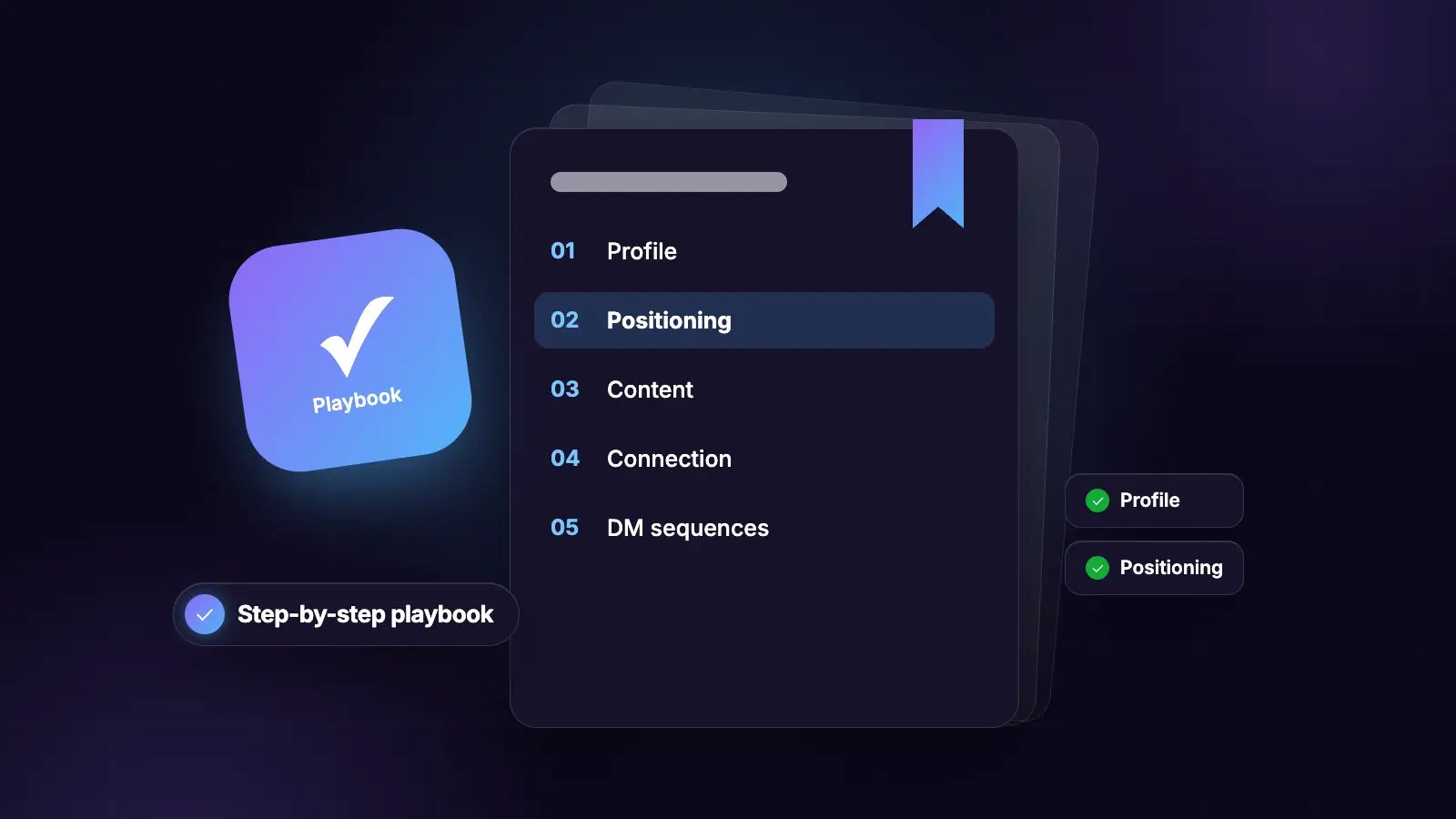
This playbook consolidates every LinkedIn module built across Conigma's lead magnet library into one system: positioning and profile, content strategy and the AI-slop moat, hook and post templates, daily engagement mechanics, Claude Cowork skills, carousel automation, and analytics through to pipeline. Prosp is referenced where it fits into the outreach layer, but this is a LinkedIn strategy playbook first.

Why LinkedIn is still the highest-leverage channel for B2B GTM right now: organic reach is suppressed on most platforms, but LinkedIn still rewards consistent, specific, well-targeted content with real distribution. A billion-plus professional users, most of them still under-served by good content, means the ceiling on this channel has not been reached yet for most B2B founders and GTM teams.

Eight modules in this playbook:

  1. Foundation: positioning and profile optimisation
  2. Content strategy: pillars, niche, and the three moats against AI-generated sameness
  3. Hook and post template library
  4. Lead magnet post formulas
  5. The daily engagement system and algorithm mechanics
  6. Claude Cowork skills for LinkedIn
  7. Carousel and post automation with Claude Code
  8. Analytics, pipeline, and turning impressions into revenue

Why most LinkedIn content plans fail before they start

Most people fail on LinkedIn for one of three reasons: no clear positioning (so nobody can describe what they help with in one sentence), no repeatable content system (so output is sporadic and inconsistent), or no distribution mechanics (so even good posts get buried).

This playbook solves all three in order. Get the foundation right first. A content calendar built on top of unclear positioning just produces more content nobody remembers.

Section 2

Module 1: Positioning and Profile Optimisation

Before writing a single post, get the foundation right: a clear point of view, a specific ICP, and a profile that actually converts profile visits into follows or connections.

Positioning before content

Pick one to three content pillars, not ten. A pillar is a specific topic you can credibly speak on from real experience: GTM engineering, outbound systems, a specific niche you serve. Trying to cover everything makes your profile forgettable. Trying to cover one thing consistently makes you the person people think of when that topic comes up.

Define your ICP specifically, not broadly. "B2B founders" is too wide. "Seed-to-Series-A B2B SaaS founders doing their own outbound before they hire an SDR" is specific enough that your content can speak directly to a real person's real problem.

Profile optimisation as a conversion layer

Treat your profile the way you would treat a landing page. Someone lands on it after seeing one post; the profile has seconds to convince them to follow, connect, or click through.

Headline: state who you help and the outcome you help them get, not just a job title. Banner image: reinforce your pillar visually. About section: open with the specific problem you solve, not a biography. Featured section: pin your best-performing content or your lead magnet, not your company's generic one-pager.

The goal of the profile is not to impress. It is to convert a stranger's curiosity into a follow within the few seconds they are actually looking at it.

Section 3

Module 2: Content Strategy and the Three Moats Against AI Slop

The content landscape changed as AI-generated posts flooded every feed. The founders and GTM teams who still grow have one thing in common: their content cannot be replicated by someone typing a prompt into ChatGPT.

The three content moats

Moat 1, Specific experience: write about what actually happened to you, with real numbers, real mistakes, and real timelines. Generic advice is infinitely replicable. A specific story about a specific client, campaign, or failure is not.

Moat 2, Original data: share numbers nobody else has. Run your own small surveys, publish your own campaign results, share your own benchmarks. Data ages better than opinion and cannot be generated by a language model that has no access to your business.

Moat 3, A distinct point of view: most posts restate consensus in slightly different words. A genuine, sometimes contrarian point of view, one you are willing to defend in the comments, is the hardest thing for AI-generated content to fake convincingly.

Applying the moats to a content calendar

Build your weekly content mix around all three moats rather than posting whatever comes to mind. A simple weekly structure: one post rooted in a specific personal experience, one post built around a number or a piece of original data, and one post that takes a clear position on something your audience debates.

Repeat weekly. The moats do not run out because your experience, your data, and your opinions keep accumulating as your business keeps operating.

Section 4

Module 3: Hook and Post Template Library

The hook is the only thing standing between your post and the scroll. Below are the highest-performing hook and post body structures, condensed from the full 50+ formula library.

Hook formulas that consistently earn the click

Specific-number hook: open with a real, specific figure that creates curiosity about how it happened. Specificity beats round numbers.

Contrarian-claim hook: state a belief that goes against what most people in your space assume, then use the rest of the post to defend it.

Mistake-confession hook: open by admitting a costly mistake. Vulnerability earns attention that polished advice does not.

Before-and-after hook: open with the gap between where something started and where it ended up, without yet explaining how.

Direct-question hook: ask the exact question your ICP is already asking themselves, worded the way they would word it, not the way a marketer would.

Post body structures

Story-to-lesson: walk through what happened in plain chronological order, then extract the one lesson at the end. Do not front-load the lesson; let the story earn it.

List-with-context: a numbered list works only when each item includes a sentence of real context, not just a bare label. Bare lists read as filler.

Problem-agitate-solve: name the problem specifically, spend one or two lines on why it is worse than people think, then give the actual solution with enough detail that it is useful on its own.

Framework reveal: name a simple framework (three steps, two questions, one rule) and walk through each part with a concrete example attached.

Section 5

Module 4: Lead Magnet Post Formulas

Lead magnet posts turn ordinary content into a pipeline mechanism: the post itself demonstrates value, and the comment-to-DM flow captures the reader's contact details in exchange for something more valuable.

The lead magnet post structure

Step 1, deliver real value in the post itself. Do not gate the entire idea behind a download. Give away a genuinely useful insight in the post so the reader trusts that the gated resource will be worth requesting.

Step 2, name the specific resource clearly. "Comment 'TEMPLATE' and I'll send it over" only works when the resource named is specific (a checklist, a swipe file, a calculator), not vague ("my thoughts").

Step 3, respond fast and personally. The comment-to-DM window is where trust is won or lost. A templated, delayed reply undoes the credibility the post just built.

Where this connects to outreach

Once someone comments and receives the resource, that interaction is a warm signal, not a cold contact. This is the exact point where a tool like Prosp becomes useful for GTM teams running LinkedIn at volume: Prosp can help manage and sequence the follow-up conversations that come out of lead magnet posts so warm commenters do not go cold while waiting on a manual reply.

Section 6

Module 5: Daily Engagement System and Algorithm Mechanics

Posting good content is necessary but not sufficient. The algorithm rewards specific daily behaviours beyond publishing, and ignoring these mechanics caps your reach regardless of content quality.

The daily engagement system

Comment before you post. Spend 10 to 15 minutes leaving genuine, specific comments on posts from people in your ICP or your niche before publishing your own post. This signals activity to the algorithm and puts your name in front of the right people ahead of your own content going live.

Reply to every comment on your own posts within the first hour. Early engagement velocity on a post is one of the strongest signals for continued distribution. A post with fast, substantive replies in the comments outperforms an identical post with no engagement from the author.

Post at a consistent time and day. Consistency helps your existing audience build a habit of checking for your content, which compounds engagement speed over time.

What the algorithm actually rewards

Dwell time (how long someone spends reading before scrolling past) and comment depth (substantive replies, not just emoji reactions) matter more than raw like counts. Write posts that require a few seconds of actual reading to grasp, and write comment replies that continue a real conversation rather than a one-line thank-you.

Section 7

Module 6: Claude Cowork Skills for LinkedIn

Claude Cowork can run a meaningful share of your LinkedIn content operation as a set of dedicated skills, each one built for a specific recurring task rather than a generic one-off prompt.

Core LinkedIn skills

Hook generator skill: takes a topic and returns multiple hook options across the different formula types (specific-number, contrarian, mistake-confession) so you are choosing between real options rather than starting from a blank page.

Post drafter skill: takes a rough idea or voice note and turns it into a fully structured post following one of the core body structures, in your established voice.

Content calendar skill: given your content pillars, generates a week or month of post topics balanced across the three content moats so you are not scrambling for ideas daily.

Engagement assistant skill: surfaces relevant posts from your ICP or niche each morning and drafts genuine comment starters for you to review and personalise before posting.

Lead magnet responder skill: drafts the DM response to send when someone comments for your lead magnet, so the reply goes out fast without sounding templated.

Setting these up

Each skill works best with a small amount of setup context: your content pillars, three to five example posts in your voice, and your ICP definition. Once that context is loaded once, every future use of the skill produces on-voice output without you re-explaining your positioning each time.

Section 8

Module 7: Carousel and Post Automation with Claude Code

Carousels consistently outperform single-image and text-only posts on dwell time, which the algorithm rewards heavily. Claude Code can automate a meaningful share of carousel and post production.

Automating carousel production

Step 1, feed Claude Code your source material: a blog post, a set of notes, a transcript, or a rough outline of the idea you want to turn into a carousel.

Step 2, have it draft the slide-by-slide structure first, separately from the visual design. Each slide should carry one idea only; cramming two ideas onto a slide is the most common carousel mistake.

Step 3, generate the actual slide text and a consistent visual template description that a design tool or template library can then populate.

Step 4, have it draft the accompanying post caption, which should tease the content of the carousel without fully restating it, so there is still a reason to swipe through.

Batch production

Once the workflow above is set up, batch multiple carousels in one session by feeding in several pieces of source material back to back. This turns carousel production from an occasional, effortful task into a weekly output you can rely on.

Section 9

Module 8: Analytics, Pipeline, and Turning Impressions into Revenue

Content and engagement only matter if they eventually convert into pipeline. This module covers what to track and how impressions actually become revenue.

What to track weekly

Impressions and reach tell you whether the algorithm is distributing your content, but they are a leading indicator, not the goal. Profile views following a specific post tell you whether that post's topic or hook actually drove curiosity about you specifically. Connection and follow requests after a post are the clearest sign that the content converted a stranger into someone tracking your work. DMs and comments requesting your lead magnet are the clearest pipeline signal available on the platform.

Turning impressions into revenue

The path from impression to revenue runs through several steps: impression, profile visit, follow or connection, engagement over time (comments, DM replies), lead magnet request or direct enquiry, then a booked call. Losing people at any step is normal; the job is to identify which step is leaking the most and fix that step specifically rather than assuming more content volume alone will fix a conversion problem.

For GTM teams running LinkedIn content alongside outbound at any real volume, a tool like Prosp fits at the sequencing and follow-up layer: once someone has engaged (commented, requested a lead magnet, sent a connection request), Prosp can help manage the structured follow-up sequence so warm engagement actually converts into booked calls instead of sitting untouched in a DM inbox.

Section 10

Quick Reference: The Full System in One Place

The full playbook condensed into one operating sequence.

The build order

Week 1: lock your positioning, pick one to three content pillars, and rebuild your profile as a conversion layer.

Week 2: build your content calendar around the three moats (specific experience, original data, distinct point of view) and select your go-to hook and post body structures.

Week 3: set up your daily engagement routine and, if using Claude Cowork, configure the hook generator, post drafter, and engagement assistant skills with your voice and pillars loaded in.

Week 4: add lead magnet posts into the rotation, set up a fast comment-to-DM response process, and if you are running outbound alongside content at volume, connect that warm-signal flow into a sequencing tool like Prosp so engaged commenters get a structured follow-up rather than a manual one-off reply.

Ongoing: track the four weekly metrics (impressions, profile views, follows, lead magnet requests), automate carousel production with Claude Code once your content rhythm is established, and revisit your content pillars every quarter as your positioning sharpens.

10 pilot places left · closes in

Run a free pilot on your own list

We source the list, write the messages in your cloned voice and send 200 of them. You approve every draft and keep every reply.

5/5 rated on Capterra·800+ agencies and sales teams·Set up in 5 minutes
10 free pilot places left this monthTry Prosp Free