


LinkedIn automation, run for you200 messages sent for you, in your voice · 10 places left · closes in Run my first campaign

GTM Engineering in 332 Claude Prompts: A Growth Consultant's Playbook

A single-source prompt bank for GTM engineers and growth consultants running B2B revenue work inside Claude. Organised into 16 functional categories covering the entire…

Try Prosp Free200 messages sent for you · 10 places left
5/5 rated on Capterra·Used by 800+ agencies and sales teams
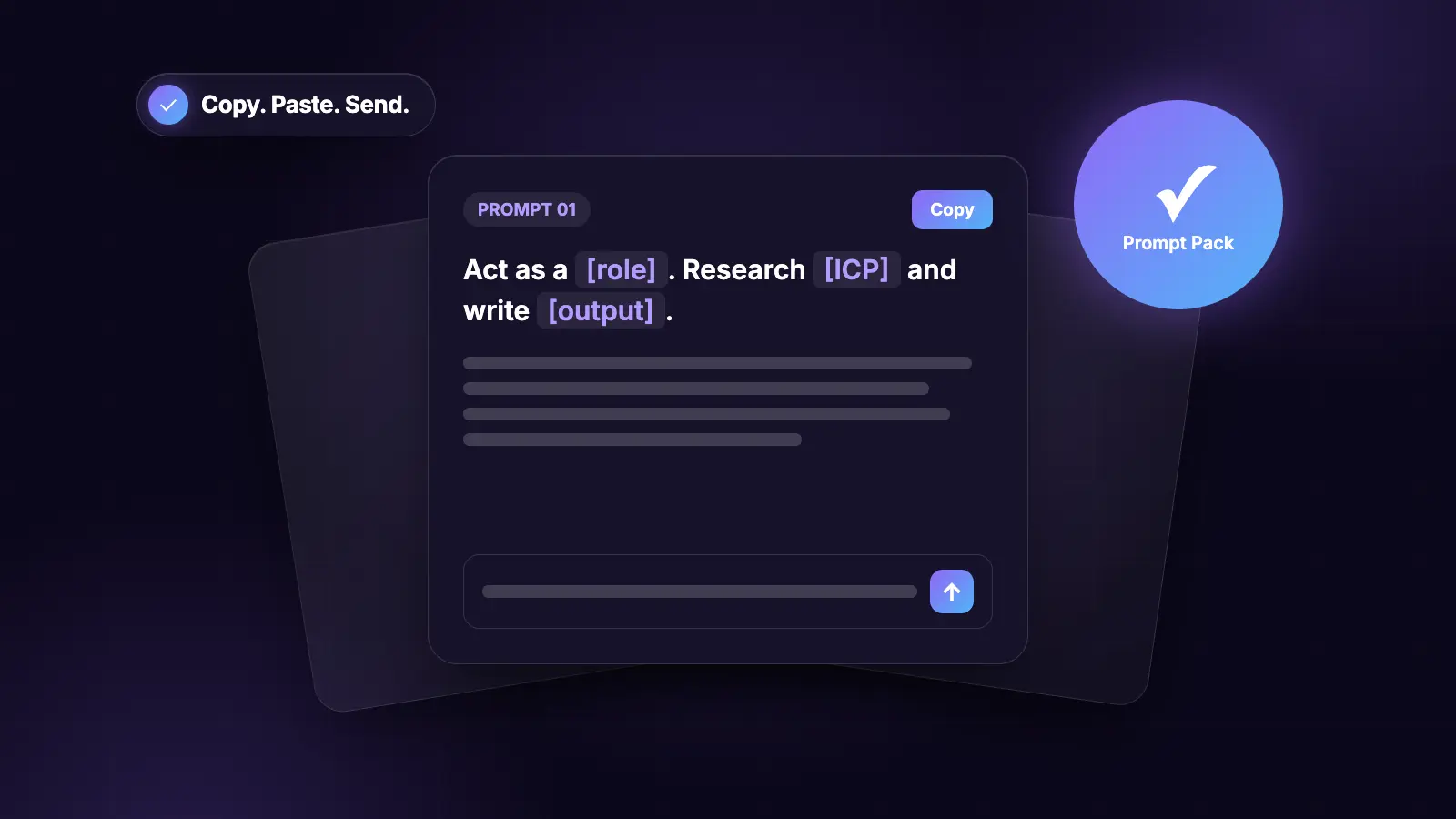
Prompt Pack18 sections
Section 1

Overview: How to Use This Bank

A single-source prompt bank for GTM engineers and growth consultants running B2B revenue work inside Claude. Organised into 16 functional categories covering the entire consultant's remit: positioning, prospecting, outreach, discovery, objections, proposals, content, SEO, competitive intelligence, RevOps, retention, reporting, campaigns, and the meta-layer of running Claude itself as a consulting practice.

Every prompt is copy-paste ready. Bracketed fields are yours to fill in. None of these require a paid plugin or skill install; paste directly into Claude chat, Cowork, or Claude Code and adjust.

16 categories, each with a full working set of prompts rather than a handful of examples:

  1. ICP and Positioning
  2. Prospecting and List Building
  3. Cold Email Outreach
  4. LinkedIn Outreach and Content
  5. Discovery and Qualification
  6. Objection Handling
  7. Proposals and Closing
  8. Competitive Intelligence
  9. Content Strategy and SEO
  10. RevOps and Pipeline
  11. Customer Success and Retention
  12. Reporting and Analytics
  13. Campaign and Launch Planning
  14. Pricing and Packaging
  15. Hiring and Team Building
  16. Running Claude as a Consulting Practice

How a growth consultant should actually use this bank

Most of these prompts get better with a CLAUDE.md context file loaded first: your client's (or your own) ICP, offer, voice, and banned phrases, written once and read by every prompt after it. Without that context, every prompt below still works, but it works better with it.

For recurring client work, package the prompts you use most often as permanent Claude skills rather than re-pasting them every session (see the Skills modules elsewhere in this workspace for the exact mechanics). This bank is the raw material; skills are what make the raw material reusable without re-typing.

Section 2

Category 1: ICP and Positioning (22 Prompts)

22 prompts covering ICP definition, positioning, messaging, and the foundational context work every other category depends on.

The 22 prompts

# 1. Full ICP definition interview
"Interview me one question at a time to build a complete ICP definition:
title/seniority, company type, size, revenue stage, funding status, the
specific problem they have right now in their own words, what they are
already doing about it, where they spend time online, and the one
disqualifier that rules someone out immediately. Save the finished
definition as icp.md."

# 2. ICP validation against closed-won deals
"Here are our last [N] closed-won deals: [PASTE DATA].
Does our current ICP definition actually match who bought?
Flag any pattern in the data that contradicts our stated ICP."

# 3. Multiple ICP segmentation
"We sell to [DESCRIBE 2-3 DIFFERENT BUYER TYPES].
Build a separate ICP definition for each, and flag anywhere our current
messaging accidentally speaks to only one segment."

# 4. The one-sentence positioning statement
"Using this format: For [ICP], who [PAIN], [BRAND] is the [CATEGORY]
that [DIFFERENTIATOR]. Unlike [ALTERNATIVE], we [PROOF POINT].
Draft 3 versions of our positioning statement from: [PASTE CONTEXT]."

# 5. The podcast test for positioning clarity
"If I were introduced on a podcast, how would the host describe what I do
in one sentence, based on: [PASTE BIO/WEBSITE/OFFER]? If that sentence is
vague or generic, tell me exactly why and propose a sharper one."

# 6. Messaging hierarchy
"Build a 4-level messaging hierarchy for [OFFER]: the primary message a
stranger would understand, the proof point, the mechanism, and the
objection handler. Keep every level in plain English."

# 7. Category creation vs category entry
"Should [OFFER] compete inside an existing category or create a new one?
Argue both sides, then give me your actual recommendation and why."

# 8. The Opposites method for positioning
"List 5 things we are deliberately NOT, to sharpen what we actually are.
For each: the opposite trait, and the one sentence explaining why we
chose not to be that."

# 9. Use Case Canvas
"Build a Use Case Canvas for [OFFER]: the trigger event that starts the
buyer's search, the job they are trying to get done, the current
alternative, and the outcome they actually want."

# 10. Buyer persona from a LinkedIn URL
"Read this LinkedIn profile: [URL]. Build a persona summary: likely
priorities, likely objections, likely internal politics they navigate,
and the one thing that would make them personally look good for
championing this purchase."

# 11. The competitor-opposite positioning check
"Read [COMPETITOR]'s homepage: [URL]. Where does our positioning overlap
with theirs almost word for word? Propose a sharper alternative for each
overlap."

# 12. Elevator pitch in 3 lengths
"Write our elevator pitch in 3 versions: a 10-second version, a 30-second
version, and a 2-minute version for a discovery call opener. Same core
message, different depth."

# 13. The 'why now' urgency statement
"Based on [MARKET CONTEXT/TREND], write the specific 'why now' argument
for why a prospect should act on this problem this quarter rather than
next year."

# 14. ICP disqualification script
"Write a polite, direct message for disqualifying a lead who does not
match our ICP: [DISQUALIFIER REASON]. Keep the door open for a referral."

# 15. Persona-to-content mapping
"For each persona in our ICP, what content format and channel do they
actually consume (LinkedIn post, long-form blog, podcast, webinar)?
Map persona to preferred format."

# 16. The anti-persona
"Who looks like our ICP on paper but is actually a bad fit? Describe this
anti-persona in detail so we can filter them out of outbound lists."

# 17. Positioning audit of existing website copy
"Read our homepage: [URL]. Does the above-the-fold copy pass the 10-second
test: can a stranger tell what we do, who it's for, and what to do next?
Flag every line that fails and rewrite it."

# 18. The value metric decision
"What should our pricing be based on: seats, usage, outcomes, or a flat
fee? Argue for the option that best fits [DESCRIBE PRODUCT/BUSINESS
MODEL] and explain the tradeoffs of the others."

# 19. Founder-market fit narrative
"Write the founder-market fit story: why is [FOUNDER NAME] specifically
the right person to build [PRODUCT]? Use only real details I provide:
[PASTE BACKGROUND]."

# 20. The category-defining manifesto
"Write a short manifesto-style post making the case for why [CATEGORY/
APPROACH] is the right way to solve [PROBLEM], contrasted with the old
way of doing it."

# 21. ICP scoring rubric
"Build a 1-10 ICP fit scoring rubric with explicit criteria per point
value, so any team member scores a lead the same way I would."

# 22. The repositioning decision memo
"We are considering repositioning from [OLD POSITIONING] to [NEW
POSITIONING]. Write a decision memo: the case for, the case against,
the risk of doing nothing, and your actual recommendation."
Section 3

Category 2: Prospecting and List Building (24 Prompts)

24 prompts covering finding prospects, building lists, enrichment, and qualification before any outreach begins.

The 24 prompts

# 23. Cold ICP list build
"Build a list of [COMPANY TYPE] matching: [ICP CRITERIA]. Source: domain
and name only, no email lookup yet. Target: [N] companies. Output as
raw-leads.csv."

# 24. Job-posting trigger list
"Find companies posting [JOB TITLE] roles in the last 14 days.
Filter: [INDUSTRY, GEO, SIZE]. Return company, posting date, website,
employee count."

# 25. Funding-signal trigger list
"Find companies that raised funding in the last 90 days matching:
[ICP CRITERIA]. Return company, round, amount, date, and one sentence
on why this signals buying intent for our offer."

# 26. Lookalike company discovery
"Seed: [5-10 DOMAINS OF BEST-FIT CUSTOMERS]. Find [N] similar companies.
For each: why it matches, size estimate, geography, contacted before (Y/N)."

# 27. Competitor customer discovery
"Find companies that are current or likely customers of [COMPETITOR],
based on public case studies, testimonials, and integration marketplace
listings."

# 28. ICP filter pass before enrichment
"Filter this raw list against our ICP: [PASTE CRITERIA]. For each row,
check the company website and mark KEEP or DROP with a one-line reason.
Output filtered-leads.csv and dropped-leads.csv."

# 29. Email pattern finder
"For each row in this list, find the company's email pattern from
publicly visible addresses, or generate the most probable pattern.
Return: guessed email, confidence (high/medium/low), pattern used."

# 30. Decision-maker extraction
"From this company list, find the most relevant decision-maker per
company matching titles: [LIST TITLES]. Return name, title, LinkedIn URL."

# 31. Bulk profile enrichment
"Enrich these LinkedIn URLs: [PASTE]. Return role, company, location,
professional email if findable. Skip anything enriched in the last 30 days."

# 32. List quality scorecard
"Grade this list across 8 dimensions: email validity, title match,
company size fit, geography match, duplicate rate, missing fields,
seniority, domain health risk. Return score per dimension and overall grade."

# 33. Competitor engager scraping
"Competitor LinkedIn posts to monitor: [URLS]. Scrape commenters and
reactors. Filter for ICP matches. Return name, title, company, which
post they engaged with."

# 34. Tech-stack based list building
"Find companies using [SPECIFIC TOOL/TECHNOLOGY] that also match:
[ICP CRITERIA]. This signal indicates [SPECIFIC PAIN OUR OFFER SOLVES]."

# 35. Event and conference attendee list
"Based on [EVENT NAME]'s public speaker list, sponsor list, or attendee
signals, build a target list of likely attendees matching our ICP."

# 36. Referral network mapping
"From our current customer list: [PASTE], who else at their companies,
or at companies they are connected to, might also match our ICP?"

# 37. Dead lead reactivation list
"From our CRM export: [PASTE], find contacts that went cold 90+ days ago
but still match our ICP. Rank by likelihood to re-engage based on their
last interaction."

# 38. Waterfall enrichment across providers
"Enrich this list. Try [PROVIDER 1] first. If no email found, try
[PROVIDER 2]. If still none, try [PROVIDER 3]. Mark the source provider
per row that succeeded."

# 39. Duplicate detection across lists
"Compare these two lists: [LIST A] and [LIST B]. Flag exact duplicates,
probable duplicates (same company, different contact), and unique entries
in each."

# 40. Territory and account mapping
"Split this account list into territories by [CRITERIA: geography, size,
vertical]. Balance territories so total addressable revenue is roughly
equal across reps."

# 41. Intent signal aggregation
"Aggregate signals for this account list from job postings, funding news,
leadership changes, and tech installs. Score and route into tiers: urgent,
weekly, monitor."

# 42. The TAM sanity check
"Given ICP criteria: [PASTE], estimate our total addressable market size.
If under [THRESHOLD], recommend how to widen the criteria without losing
fit."

# 43. LinkedIn Sales Navigator search string builder
"Build the exact Sales Navigator filter combination (titles, seniority,
company size, geography, keywords) for this ICP: [PASTE]."

# 44. Prospect research brief before first contact
"Research [COMPANY NAME] and [CONTACT NAME]. Return: company overview,
recent news, the contact's likely priorities, and one specific detail to
reference in outreach."

# 45. List segmentation by buying stage
"Segment this list into cold, warm (engaged with content), and hot
(showed direct signal) based on: [DESCRIBE AVAILABLE SIGNAL DATA].

# 46. The disqualification sweep
"Run this list against our disqualifiers: [LIST]. Remove any row matching
a disqualifier and log the reason removed."
Section 4

Category 3: Cold Email Outreach (26 Prompts)

26 prompts covering the full cold email motion: personalisation, sequences, subject lines, and deliverability.

The 26 prompts

# 47. The personalisation waterfall
"For [PROSPECT], check signals in this order: hiring signal, tech stack,
content/positioning signal, company milestone, fallback. Use the first
one you can verify. Write the opener using it."

# 48. Signal-led first line
"Prospect: [NAME/COMPANY]. Signal: [SPECIFIC SIGNAL]. Write one opening
line under 25 words that references this signal without sounding
templated."

# 49. The 4-line cold email
"Write a cold email in exactly 4 lines: personalised opener, problem
connection, one-sentence offer, soft CTA. Under 100 words total."

# 50. Subject line generator (5 mechanisms)
"Write 5 subject lines for this email using different mechanisms:
curiosity gap, specific number, contrarian claim, pain recognition,
stakes escalation. Under 33 characters each."

# 51. 3-touch sequence
"Write a 3-touch sequence for [PROSPECT/SIGNAL]. Touch 1 (day 1): the
opener. Touch 2 (day 3): different angle. Touch 3 (day 7): honest
breakup, no guilt."

# 52. 5-touch sequence with multiple channels
"Write a 5-touch sequence combining email and LinkedIn: email, LinkedIn
connection note, email, LinkedIn comment engagement, final email breakup."

# 53. The reverse lead magnet pitch
"I built [TOOL/ASSET] specifically relevant to [PROSPECT]'s situation.
Write the email offering to send it, framed as something built for them
specifically, not a generic resource."

# 54. Email QA checklist
"Check this email draft: [PASTE]. Word count under 100? No em dashes?
No banned phrases? One CTA only? Signal confidence noted? Fix anything
that fails."

# 55. Bulk personalisation from a CSV
"Read [LEADS CSV]. For each row, write a 3-sentence cold email
referencing the signal in the signal column. Under 90 words. Score each
1-10 before including it, only return 7+."

# 56. The competitor-displacement email
"Prospect currently uses [COMPETITOR]. Write an email that references
their likely frustration with [SPECIFIC COMPETITOR WEAKNESS] without
naming the competitor directly."

# 57. Re-engagement email for a cold lead
"This lead went cold [N] days ago. Write a re-engagement email that
references something new (a company change, a relevant industry event)
rather than just 'checking in'."

# 58. The mutual-connection email
"We share a mutual connection with [PROSPECT]: [CONNECTION NAME]. Write
an email that references this naturally without sounding like a namedrop."

# 59. Post-webinar or event follow-up email
"Prospect attended [EVENT/WEBINAR]. Write a follow-up email referencing
the specific session or topic, connecting it to our offer."

# 60. The proof-first email
"Lead with a specific, real result: [PASTE METRIC/CASE STUDY]. Write an
email where the proof point is the hook, not buried in paragraph 3."

# 61. Deliverability-safe email audit
"Check this email for spam-trigger language, excessive links, and
formatting that could hurt deliverability. Rewrite anything flagged."

# 62. The founder-to-founder email
"Write a founder-to-founder cold email: more informal, more direct, no
sales language, referencing [SPECIFIC SHARED CONTEXT]."

# 63. Multi-threading email to a second stakeholder
"We have been talking to [CONTACT 1] at [COMPANY]. Write an email to
introduce [CONTACT 2, a different stakeholder] referencing the existing
conversation appropriately."

# 64. The one-question email
"Write a cold email that asks exactly one specific, easy-to-answer
question as the entire CTA, nothing else."

# 65. Warm intro request email
"Write an email to [MUTUAL CONNECTION] asking for an introduction to
[TARGET PROSPECT], making it easy for them to forward with minimal effort."

# 66. The 'saw you were hiring' angle
"Prospect's company posted a [ROLE] job listing. Write an email
connecting this hire to the pain our offer solves, without being creepy
about the research."

# 67. Email reply classifier
"Classify this reply: [PASTE]. Categories: positive interest, positive
but busy, objection, not interested, out of office, escalate to human.
Suggest the next message if applicable."

# 68. The breakup email that gets replies
"Write a final breakup email for a non-responsive thread. Honest, no
guilt, leaves the door open, and includes one line that might actually
prompt a reply out of curiosity."

# 69. Email A/B test variant generator
"Take this email: [PASTE]. Generate 3 variants testing different single
variables: subject line, opening line, and CTA, changing only one
element per variant."

# 70. Vertical-specific compliance check
"This email is going to [REGULATED INDUSTRY: healthcare/finance/legal].
Check for any claim or language that could be a compliance issue and flag it."

# 71. The 'no meeting ask' first email
"Write a first-touch email that does NOT ask for a meeting. Instead ask
for permission to send one specific piece of relevant information."

# 72. Email sequence performance diagnostic
"Our sequence has a [X]% open rate and [Y]% reply rate. Given the emails:
[PASTE SEQUENCE], diagnose whether the subject lines, the copy, or the
targeting is the likely bottleneck."
Section 5

Category 4: LinkedIn Outreach and Content (26 Prompts)

26 prompts covering LinkedIn connection notes, DM sequences, content, and engagement.

The 26 prompts

# 73. Connection note from post engagement
"Prospect commented on this post: [PASTE COMMENT/CONTEXT]. Write a
connection note under 200 characters referencing it. No pitch."

# 74. Connection note with no context available
"No specific signal available beyond their profile. Write a connection
note referencing one real, specific detail from their profile or company,
never a generic opener."

# 75. Warm DM 3-touch sequence
"Relationship started via: [comment/mutual connection/cold accept].
Write touch 1 (within 24 hours, references the start context), touch 2
(3 days later, different angle), touch 3 (7 days later, honest check-in)."

# 76. LinkedIn reply classifier
"Classify this DM reply: [PASTE]. Positive interest, positive but busy,
neutral question, objection, not interested, escalate to human. Suggest
next message if applicable."

# 77. Post engager scoring
"Score these post engagers by ICP fit and engagement depth: [PASTE LIST].
Combined priority = engagement depth (1-3) x ICP fit (1-3). Rank highest first."

# 78. LinkedIn post writer with hook selection
"Write a LinkedIn post about [TOPIC]. Select the hook type based on the
idea (specific-number, contrarian, mistake-confession, before-and-after,
direct-question) and name it. Under 200 words."

# 79. The write-hook-last edit
"Here is a full post draft: [PASTE]. Find the sharpest, most specific
line already inside it and move it to the top as the hook. Do not invent
a new one."

# 80. Hook extractor from a viral post
"Reverse-engineer the hook formula from this post: [PASTE]. Return a
blank, fillable template using the same structure for my own topic."

# 81. Content moat check
"Check this post for a content moat: is there a narrative, data, or
physical detail only I could have included? Could this exact post have
been written by anyone typing the topic into Claude? Flag if it fails."

# 82. Humanizer pass (strip AI tells)
"List every phrase in this draft that reads as generic or AI-generated:
[PASTE]. Rewrite each flagged section in plainer, more specific language.
Keep everything else unchanged."

# 83. 7-day content calendar
"Build a 7-day LinkedIn content plan from these pillars: [LIST]. For each
day: topic, hook type, format, posting time. No hook type repeats twice
in one week."

# 84. Carousel structure from source material
"Source: [PASTE BLOG POST/TRANSCRIPT]. Draft a slide-by-slide carousel
structure. One idea per slide. Include a title slide, 3-4 body slides,
and a closing CTA slide."

# 85. Comment that adds real value
"Write a comment on this post: [PASTE POST]. Must add something the post
did not say. No generic praise. 2-3 sentences."

# 86. Feed engagement session
"Find recent posts from ICP-matching profiles: [DESCRIBE ICP]. For each,
draft a 2-3 sentence comment that adds value, never mentions our product."

# 87. Post-comment-to-DM lead magnet response
"Someone commented '[KEYWORD]' on our lead magnet post. Draft the DM
delivering the resource, referencing their specific comment, ending with
a soft open-ended question."

# 88. The AI slop detector for LinkedIn
"Read this post: [PASTE]. Would someone recognise this as AI-written?
Flag any triple-adjective stacks, em dashes, rhetorical question openers,
or generic superlatives with no number attached."

# 89. LinkedIn profile audit
"Audit this profile against: headline structure, About section (problem-
solution-proof-CTA), Featured section relevance, Experience bullet
quality, skills list focus. Rank issues by priority."

# 90. Headline rewrite
"Current headline: [PASTE]. ICP: [PASTE]. Write 3 headline options
following: who you help + specific outcome + credibility marker."

# 91. About section rewrite
"Rewrite this About section: [PASTE]. Structure: hook, problem, proof,
CTA. First person. Primary keywords in the first 2 lines."

# 92. Total addressable content finder
"Given ICP: [PASTE], what is this audience currently watching, reading,
and reacting to on LinkedIn right now? Use this to seed content ideas."

# 93. Borrowed-reach content formatter
"Take this topic: [TOPIC]. Draft it in 5 formats: brand-jacking,
newsjacking, referencing a known figure, hot take, trend-riding. Return
all 5 so I can pick the strongest angle."

# 94. LinkedIn-to-X thread converter
"Convert this LinkedIn post into an X thread: [PASTE]. Hook tweet must
work standalone. Under 280 characters per tweet. 5-7 tweets."

# 95. The ICP list builder for cold campaigns
"Build a fresh LinkedIn prospect list from: [ICP CRITERIA]. Target size:
[N]. Prioritise profiles with activity in the last 14 days."

# 96. Weekly LinkedIn performance diagnostic
"This week's metrics: [PASTE]. Which posts got the most engagement and
why? Which hook type or format should I do more of next week?"

# 97. Employee advocacy content brief
"Write a brief for [TEAM MEMBER] to post about [TOPIC] in their own
voice, tied to our brand message but not sounding like corporate copy."

# 98. The DM self-check for over-pitching
"Count uses of I/we/our/my against you/your in this DM: [PASTE]. If the
first count is higher, rewrite to be about them."
Section 6

Category 5: Discovery and Qualification (22 Prompts)

22 prompts covering discovery calls, qualification frameworks, and getting to the real problem fast.

The 22 prompts

# 99. Discovery call question bank
"Build a discovery call question set for [DEAL TYPE/ICP] covering:
current state, desired state, decision process, timeline, budget signal,
and competing priorities. 12-15 questions max."

# 100. SPICED framework application
"Apply the SPICED framework (Situation, Pain, Impact, Critical event,
Decision) to this call transcript: [PASTE]. What is missing that we
need to uncover next call?"

# 101. MEDDIC scorecard from a transcript
"Score this deal against MEDDIC (Metrics, Economic buyer, Decision
criteria, Decision process, Identify pain, Champion) from this
transcript: [PASTE]. Flag every gap."

# 102. Challenger-style reframe
"Given this prospect's stated problem: [PASTE], write a Challenger-style
reframe that teaches them something surprising about their situation
before pitching a solution."

# 103. SPIN question sequence
"Write a SPIN question sequence (Situation, Problem, Implication, Need-
payoff) for uncovering the cost of [SPECIFIC PROBLEM] in a discovery call."

# 104. Gap Selling current-state future-state map
"Map the current state and future state gap for this prospect: [PASTE
CONTEXT]. What specifically closes that gap, and what is the cost of
staying in the current state?"

# 105. Economic buyer identification
"Based on this org chart or context: [PASTE], who is the likely economic
buyer, and who is the likely champion? What does each of them personally
care about?"

# 106. The pain-in-their-own-words extractor
"From this transcript: [PASTE], extract exactly what the prospect said
about their pain, in their own words, not our interpretation of it."

# 107. Qualification scoring from a call
"Score this call transcript: [PASTE] against our ICP criteria: [PASTE].
Return: fit score 1-10, heat (hot/warm/cold), recommended next step."

# 108. Multi-threading question prompt
"Based on this call, who else internally is likely involved in this
decision? Draft the question to ask the prospect to surface the full
buying committee."

# 109. Budget conversation opener
"Write 3 different ways to raise the budget question naturally in a
discovery call without it feeling like an interrogation."

# 110. Timeline and urgency probe
"Write questions that surface whether there is a real forcing function
(a deadline, an event, a consequence) behind this prospect's timeline,
rather than a vague 'soon'."

# 111. Competing priorities uncovering
"Write questions to surface what else is competing for this prospect's
attention and budget right now, so we know our real competition isn't
just other vendors."

# 112. Discovery call summary and next steps
"Summarise this call transcript: [PASTE] into: pain in their words,
decision process, timeline, what they need to see next, agreed next step
with date, ICP fit rating."

# 113. The 'what happens if you do nothing' question
"Write the exact phrasing to ask what happens if this prospect does
nothing about this problem, in a way that doesn't sound like a scare tactic."

# 114. Discovery call self-review
"Review this call transcript where I was the rep: [PASTE]. Did I talk
too much? Did I ask enough open questions? What should I do differently
next call?"

# 115. Second-call agenda based on first-call gaps
"From this first-call summary: [PASTE], what specifically should the
second call agenda cover to close the remaining qualification gaps?"

# 116. The champion enablement brief
"Our champion is [NAME/ROLE]. Write a brief they can use internally to
sell this to their own stakeholders, in their words, not ours."

# 117. Qualification disqualification memo
"Based on this transcript: [PASTE], should we disqualify this deal?
Argue both sides, then give your actual recommendation."

# 118. Discovery call script for a specific persona
"Write a discovery call script tailored to [SPECIFIC PERSONA, e.g.
CFO vs end user], adjusting the language and priorities addressed."

# 119. The decision criteria elicitation
"Write questions to surface exactly what criteria this prospect will use
to evaluate options, and in what order those criteria are weighted."

# 120. Post-call CRM update draft
"From this call transcript: [PASTE], draft the CRM update: stage, next
step, key notes, and any risk flags, in the format our team uses: [PASTE FORMAT]."
Section 7

Category 6: Objection Handling (18 Prompts)

18 prompts covering the most common objections and how to respond across phone, email, and live calls.

The 18 prompts

# 121. The 'we already have something' objection
"Write a phone response (under 30 seconds) and an email response for the
objection 'we already have something for this', that asks what gap
exists in their current solution rather than dismissing it."

# 122. The 'not ready right now' objection
"Write responses for 'we're not ready right now' that distinguish
between a timing issue and a priority issue, so I know whether to follow
up in 3 months or push now."

# 123. The 'price is too high' objection
"Write responses for a pricing objection that separate whether the
absolute number is the issue or whether the value relative to cost is
unclear, since those need different responses."

# 124. The 'I need to talk to my team' objection
"Write a response that offers to help build the internal case (a
one-pager, a demo recording, a case study) rather than just waiting
passively for their answer."

# 125. The 'budget freeze' objection
"Write a response asking whether the freeze is across the board or
whether specific budget lines are still moving, without being pushy."

# 126. The 'we're happy with our current vendor' objection
"Write a response that acknowledges their satisfaction while surfacing
one specific gap our offer covers that a happy customer might not have
noticed yet."

# 127. The 'send me more information' stall
"Write a response to 'just send me some info' that asks one clarifying
question before sending anything, to avoid the info disappearing into a
black hole."

# 128. The 'this isn't a priority right now' objection
"Write a response connecting our offer to whatever IS their stated
priority: [PASTE THEIR STATED PRIORITY], rather than arguing our offer
should be the priority."

# 129. The 'we tried something like this before and it didn't work' objection
"Write a response asking specifically what went wrong last time, then
addressing that specific failure mode directly rather than making a
generic reassurance."

# 130. The 'I don't have decision-making power' objection
"Write a response that asks who else needs to be involved, and offers to
help equip them to bring it to that person."

# 131. The silent-ghost objection (no response at all)
"Write a re-engagement message for a prospect who has gone completely
silent after 2 previous touches, using a different angle than either
previous message."

# 132. The 'competitor is cheaper' objection
"Write a response addressing a cheaper competitor without disparaging
them directly, focused on the specific value gap between the two options."

# 133. The 'we're too small for this' objection
"Write a response for a prospect who thinks they are too small to need
our offer, addressing the specific pain point that applies regardless of size."

# 134. The 'we're too big, this won't scale' objection
"Write a response for a prospect worried our offer will not scale to
their size, addressing enterprise-readiness concerns directly."

# 135. The stakeholder objection relay
"Our champion says their boss raised this objection: [PASTE]. Write the
response our champion can relay internally, in their own words style."

# 136. The 'we need to see ROI proof first' objection
"Write a response offering a specific, low-risk way to demonstrate ROI
before a full commitment, tailored to: [OFFER]."

# 137. Objection pattern analysis across lost deals
"From these lost-deal notes: [PASTE], what is the most common objection
pattern? Propose a proactive way to address it earlier in the sales
process before it becomes a blocker."

# 138. Live-call objection handling cheat sheet
"Build a one-page cheat sheet of our top 5 objections with a 1-sentence
response to each, formatted for glancing at during a live call."
Section 8

Category 7: Proposals and Closing (20 Prompts)

20 prompts covering proposal generation, pricing conversations, and closing mechanics.

The 20 prompts

# 139. Proposal from a call transcript
"Generate a full proposal from this discovery call transcript: [PASTE].
Include: their stated problem in their words, our recommended solution,
pricing, timeline, and next steps."

# 140. The one-page executive summary proposal
"Condense our full proposal: [PASTE] into a single-page executive
summary for a time-poor decision-maker: problem, solution, investment,
outcome, next step."

# 141. ROI calculation for a proposal
"Build the ROI case for this proposal: [PASTE OFFER + PRICING]. Show the
cost of the current state versus the cost of our solution over 12 months."

# 142. Multi-tier pricing presentation
"Present these 3 pricing tiers: [PASTE] in a way that makes the middle
tier the obvious recommended choice without being manipulative."

# 143. The proposal objection pre-empt
"Given what we know about this prospect's likely objections: [PASTE],
what should we address proactively in the proposal itself before they
raise it?"

# 144. Contract redline first pass
"Review this contract redline from the prospect's legal team: [PASTE].
Flag which changes are standard and low-risk versus which need real
negotiation."

# 145. The verbal-to-written close confirmation
"Prospect verbally agreed to move forward on the call. Write the follow-
up email confirming the agreement and outlining exactly what happens next."

# 146. Deal desk pricing exception request
"Write the internal request for a pricing exception for this deal:
[PASTE CONTEXT], including the business case for why it's worth approving."

# 147. The urgency-without-pressure close
"Write a closing message that creates genuine urgency (a real deadline,
a real constraint) without resorting to fake scarcity language."

# 148. Multi-stakeholder proposal customisation
"We are presenting to [STAKEHOLDER 1: technical] and [STAKEHOLDER 2:
financial]. Adjust this proposal to speak to both audiences within one
document."

# 149. The 'what would it take' close question
"Write the exact phrasing for asking a stalled prospect what it would
take to move forward, in a way that surfaces the real blocker."

# 150. Proposal follow-up after silence
"We sent a proposal [N] days ago with no response. Write a follow-up that
adds new value rather than just asking 'any updates?'"

# 151. The competitive bake-off response
"We know this prospect is evaluating [COMPETITOR] alongside us. Write the
follow-up that reinforces our specific differentiators without directly
attacking the competitor."

# 152. Deal risk assessment before close
"Assess this deal for risk before we close it: [PASTE CONTEXT]. Champion
strength, economic buyer engagement, timeline realism, budget confirmation.
Flag any red flags."

# 153. The soft downsell for a stalled deal
"This deal has stalled at the full package price. Write a message
offering a smaller starting scope that still delivers real value and
keeps expansion open later."

# 154. Contract renewal proposal
"Write the renewal proposal for this existing customer: [PASTE ACCOUNT
CONTEXT], including any expansion opportunity based on their usage."

# 155. The close-lost win-back sequence
"This deal was lost [N] months ago to [REASON]. Write a re-engagement
sequence checking if circumstances have changed."

# 156. Legal and procurement navigation email
"Write an email to a prospect's procurement team explaining our terms in
plain language, addressing common procurement concerns proactively."

# 157. The signed-deal onboarding kickoff
"Deal just closed. Write the kickoff email that sets expectations for the
next 30 days and reinforces the decision they just made."

# 158. Win-loss debrief prompt
"We just [won/lost] this deal: [PASTE CONTEXT]. Run a structured win-loss
analysis: what worked, what didn't, and what to change for next time."
Section 9

Category 8: Competitive Intelligence (18 Prompts)

18 prompts covering competitor research, battlecards, and positioning against alternatives.

The 18 prompts

# 159. Full competitive brief
"Research [COMPETITOR] from their website, G2 reviews (last 90 days),
LinkedIn (last 30 days), and job postings. Return: positioning in their
words, top 5 customer complaints, hiring signals, our unique claim."

# 160. Battlecard generator
"Build a sales battlecard for [COMPETITOR]: their positioning, their
strengths, their weaknesses, 3 discovery questions that surface where
they lose, and what to say when their name comes up."

# 161. Competitive pricing page diff
"Compare [COMPETITOR]'s current pricing page against this saved baseline:
[PASTE]. Summarise every change in plain English."

# 162. Comparison landing page copy
"Write the copy for a '[US] vs [COMPETITOR]' landing page: feature
comparison table, balanced framing, clear CTA, without disparaging them."

# 163. G2 review mining for weaknesses
"Read these G2 reviews for [COMPETITOR]: [PASTE]. Extract the 5 most
common complaints in the reviewers' own words."

# 164. Hiring signal analysis
"[COMPETITOR] posted these job listings: [PASTE]. What does this reveal
about their roadmap or strategic priorities for the next 6-12 months?"

# 165. The 'what to say when their name comes up' script
"Write the exact phrasing for handling '[COMPETITOR] came up in our
evaluation' on a live call, acknowledging them fairly while pivoting to
our strength."

# 166. Win/loss pattern analysis vs a specific competitor
"From these deal notes where we competed against [COMPETITOR]: [PASTE],
what pattern explains why we won or lost most often?"

# 167. Competitor content gap analysis
"What topics is [COMPETITOR] NOT covering in their content that our ICP
cares about? Use this to identify content opportunities."

# 168. Feature parity tracker update
"Given this list of new features [COMPETITOR] shipped: [PASTE], update
our feature parity tracker and flag any genuine gap we now have."

# 169. The category map
"Map every real competitor and adjacent alternative in this category:
[CATEGORY]. Segment by approach (direct competitor, adjacent tool,
status-quo/manual process, build-your-own).

# 170. Competitor pricing model analysis
"[COMPETITOR]'s pricing model is: [DESCRIBE]. What does this incentivise
for their customers, and where does our model create a genuine
advantage or disadvantage?"

# 171. Social listening for competitor mentions
"Monitor mentions of [COMPETITOR] across public channels. Summarise
sentiment themes and flag anything that represents a genuine opportunity
for us."

# 172. The honest competitive weakness audit
"Where do WE genuinely lose to [COMPETITOR]? Be honest, not defensive.
What is the real gap and how do we either close it or reframe around it?"

# 173. New entrant threat assessment
"A new competitor, [NAME], just launched: [PASTE CONTEXT]. Assess the
real threat level and what, if anything, we should change in response."

# 174. Competitor customer testimonial analysis
"Read [COMPETITOR]'s published case studies: [PASTE/URLS]. What outcomes
are they claiming, and which of our customers could counter with a
stronger, more specific result?"

# 175. Alternative-to-X SEO page brief
"Write the content brief for an 'alternatives to [COMPETITOR]' page
targeting search intent from people actively comparing options."

# 176. Quarterly competitive landscape summary
"Summarise everything that changed across our top 3 competitors this
quarter: pricing, product, messaging, and hiring signals, into one
executive-ready brief."
Section 10

Category 9: Content Strategy and SEO (24 Prompts)

24 prompts covering content strategy, SEO, and organic growth planning.

The 24 prompts

# 177. Content pillar definition
"Based on our ICP: [PASTE] and our positioning: [PASTE], define 3-5
content pillars we can credibly own with authority."

# 178. SEO content brief
"Write a full content brief for the keyword [KEYWORD]: search intent,
target word count, H2/H3 structure, internal linking opportunities, and
the AI Search angle to make this citable.

# 179. Keyword clustering
"Group these keywords into intent-based clusters with a pillar-plus-
spokes structure: [PASTE KEYWORD LIST]. Suggest H1/H2s per spoke."

# 180. Technical SEO audit summary
"Given this list of technical issues: [PASTE], prioritise into a top-10
fix list ranked by severity times affected pages divided by effort."

# 181. AI Search / GEO optimisation pass
"Review this article: [PASTE] for AI Search citability. What is missing
that would make ChatGPT or Perplexity more likely to cite this as a source?"

# 182. Content repurposing from one source
"Source: [PASTE ARTICLE/TRANSCRIPT]. Produce: 3 LinkedIn posts (different
hooks), 1 X thread, 1 newsletter section, 3 social captions."

# 183. Competitor content gap finder
"What high-value topics is [COMPETITOR] ranking for that we have no
content on? Prioritise by estimated search volume and buyer relevance."

# 184. Comparison page content brief
"Write the content brief for a '[US] vs [ALTERNATIVE]' page: structure,
feature table, balanced tone, schema recommendations, CTA flow."

# 185. Schema markup generator
"Generate JSON-LD schema for this page type: [Article/Product/FAQ/
LocalBusiness]. Content: [PASTE PAGE DETAILS]."

# 186. Content freshness audit
"Review this existing article: [PASTE/URL]. Is it still accurate? What
needs updating, and does it need a full rewrite or a light refresh?"

# 187. Programmatic SEO template design
"Design a programmatic SEO page template for [USE CASE, e.g. city pages,
integration pages]. What variables change per page, and what stays constant?"

# 188. Content calendar for a quarter
"Build a 90-day content calendar across [CHANNELS] from these pillars:
[PASTE], balanced so no single pillar dominates any given month."

# 189. The customer-language content mining prompt
"Mine these customer support tickets/reviews/call transcripts: [PASTE]
for real language customers use about their problem, to inform content topics.

# 190. Backlink gap analysis
"Which domains link to [COMPETITOR 1] and [COMPETITOR 2] but not to us?
Prioritise by domain authority and outreach feasibility."

# 191. Content distribution plan
"For this piece of content: [DESCRIBE], plan the distribution: which
channels, in what sequence, with what repurposed format per channel."

# 192. Site architecture and internal linking review
"Review our site structure: [PASTE SITEMAP/DESCRIPTION]. Flag any orphan
pages, unclear hierarchy, or missed internal linking opportunities."

# 193. Local SEO audit for a multi-location business
"Audit local search presence for [BUSINESS/LOCATIONS]: Google Business
Profile signals, NAP consistency, citation footprint, local-pack rank."

# 194. Image SEO audit
"Audit image SEO for this page: [URL/PASTE]. Alt-text quality, format
(WebP/AVIF), lazy loading, file naming. Return paste-ready fixes."

# 195. Content performance diagnostic
"This piece got [X] views and [Y] conversions. Diagnose whether the
traffic quality, the content itself, or the CTA is the likely bottleneck."

# 196. The pillar page structure builder
"Design a pillar page structure for [TOPIC] that internally links to
[N] supporting cluster articles, optimised for both traditional search
and AI Search citation."

# 197. Content ROI reporting
"Given this content performance data: [PASTE], build a report showing
which pieces drove pipeline, not just traffic."

# 198. Newsletter section from company updates
"Turn these company updates: [PASTE] into 3-5 newsletter items with a
signature story lead, in our brand voice."

# 199. The AI-citation gap finder
"For target queries: [LIST], which of our competitors currently get cited
in AI-generated answers, and what content gap explains why we don't?"

# 200. Case study structure from a client win
"Write a case study using the problem-solution-result structure from
this client context: [PASTE], including a specific, real proof point."
Section 11

Category 10: RevOps and Pipeline (22 Prompts)

22 prompts covering pipeline hygiene, forecasting, and RevOps diagnostics.

The 22 prompts

# 201. The RevOps diagnostic
"Given this pipeline and process context: [PASTE], run a diagnostic to
find the actual constraint in our revenue system before recommending
any fix."

# 202. Pipeline health audit
"Audit this pipeline export: [PASTE]. Flag deals stalled 30+ days in
stage, deals with a close date in the past, and any stage with an
unusually low conversion rate."

# 203. Forecast accuracy check (MAPE)
"Compare our forecast to actual results over the last [N] periods:
[PASTE]. Calculate MAPE and flag whether we tend to over- or under-forecast."

# 204. CRM data quality audit
"Review this CRM export for data quality: [PASTE]. Flag missing fields,
inconsistent naming conventions, and duplicate records."

# 205. Lead routing logic review
"Review our lead routing rules: [PASTE]. Where are leads likely getting
misrouted or delayed based on the criteria as written?"

# 206. Job title normalisation
"Normalise these job titles into a canonical taxonomy: [PASTE LIST].
Output a full audit log of every change made."

# 207. Revenue handoff mapping
"Map our marketing-to-sales-to-CS handoff points: [DESCRIBE PROCESS].
Where do deals or accounts most likely get dropped in these handoffs?"

# 208. Territory and quota planning
"Given this account list and rep count: [PASTE], propose a territory
split that balances total addressable revenue roughly equally."

# 209. Compensation plan design
"Design a comp plan for [ROLE] with quota of [X] and OTE of [Y].
Base/variable split, accelerators, and any spiff structure."

# 210. Rule of 40 and LTV:CAC calculation
"Given growth rate [X]% and profit margin [Y]%, calculate our Rule of 40
score. Given CAC of [Z] and LTV of [W], calculate LTV:CAC and flag if
it's healthy."

# 211. Deal velocity diagnostic
"Given average sales cycle length by stage: [PASTE], identify which
stage is inflating cycle time the most and propose exit criteria fixes."

# 212. NRR/GRR whitespace analysis
"Given this customer usage data: [PASTE], identify accounts with
unrealised expansion opportunity based on usage patterns."

# 213. Tech stack evaluation
"We are evaluating [TOOL A] vs [TOOL B] for [USE CASE]. Compare on:
integration capability, cost at our scale, and migration risk."

# 214. RevOps org design by stage
"Given our current ARR of [X] and team size of [Y], what RevOps roles
should we hire next, in what sequence?"

# 215. Operating cadence design
"Design our revenue operating cadence: which metrics get reviewed daily,
weekly, monthly, and quarterly, and by whom."

# 216. QBR data compilation
"Compile this quarter's data into a QBR-ready format: pipeline generated,
win rate, average deal size, and the 3 things that moved the needle most."

# 217. Sales methodology fit assessment
"Given our average deal size of [X] and sales cycle of [Y] days, which
sales methodology (SPICED, MEDDIC, Challenger, SPIN, Gap Selling) fits
best, and why?"

# 218. Revenue leakage scan
"Given this billing and usage data: [PASTE], identify any signs of
revenue leakage: under-billed usage, expired discounts still applied,
or churned accounts still being charged."

# 219. Partner/channel program design
"Design a partner program structure: enablement materials needed,
co-selling process, and deal registration rules."

# 220. Crisis triage when multiple systems break
"Our [CRM/marketing automation/billing system] just broke simultaneously
with [DESCRIBE SYMPTOMS]. Triage: what's the most urgent fix, and what
can wait?"

# 221. Data governance policy draft
"Draft a data governance policy for our CRM covering: required fields,
naming conventions, and who owns data quality for each object type."

# 222. Change management plan for a new RevOps process
"We are rolling out [NEW PROCESS/TOOL] to the sales team. Draft a change
management plan: communication, training, and adoption tracking."
Section 12

Category 11: Customer Success and Retention (20 Prompts)

20 prompts covering onboarding, health scoring, renewals, and expansion.

The 20 prompts

# 223. Customer health scoring model
"Design a customer health score using: [LIST AVAILABLE SIGNALS: usage,
support tickets, NPS, login frequency]. Weight each signal and define
the healthy/at-risk/critical thresholds."

# 224. Onboarding sequence for a new customer
"Design a 30-day onboarding sequence for a new [PRODUCT] customer:
milestones, check-in cadence, and the activation event that predicts
long-term retention."

# 225. Churn risk early warning
"Given this account's usage trend: [PASTE], is this account at churn
risk? What is the earliest signal that should have triggered an
intervention?"

# 226. Renewal proposal with expansion
"Write the renewal proposal for [ACCOUNT]: current usage, value
delivered, and a specific expansion opportunity based on their growth."

# 227. Save offer for an at-risk renewal
"This account is showing churn signals ahead of renewal: [PASTE
CONTEXT]. Draft the save conversation and any offer that addresses
their specific concern."

# 228. QBR deck outline for a customer
"Build a QBR outline for [ACCOUNT]: value delivered this period, usage
trends, and next-period goals aligned to their business objectives."

# 229. Whitespace analysis for expansion
"Given this account's current usage and org size: [PASTE], where is the
unrealised expansion opportunity: more seats, a higher tier, or an
adjacent product?"

# 230. CS-to-Sales handback for expansion deals
"This expansion opportunity needs a sales-led motion: [PASTE CONTEXT].
Draft the handback brief from CS to sales with all relevant context."

# 231. NPS follow-up for a detractor
"This customer gave a low NPS score with comment: [PASTE COMMENT]. Draft
a personal follow-up that addresses their specific feedback."

# 232. NPS follow-up for a promoter
"This customer gave a high NPS score. Draft a follow-up asking for a
testimonial, referral, or case study participation."

# 233. Feature adoption campaign
"We shipped [NEW FEATURE]. Draft a campaign to drive adoption among
existing customers who would benefit most, based on their usage pattern."

# 234. Support ticket theme analysis
"Analyse these support tickets: [PASTE] for recurring themes. Which
issues, if fixed, would most reduce churn risk?"

# 235. Customer advocacy program pitch
"Draft the pitch inviting our happiest customers into an advocacy
program: what's in it for them, and what we're asking in return."

# 236. Win-back campaign for churned customers
"Draft a win-back sequence for customers who churned [N] months ago,
checking if their situation or our product has changed enough to
reconsider."

# 237. Customer segmentation by value and risk
"Segment our customer base: [PASTE DATA] into a 2x2 of value (high/low)
and risk (high/low). What action does each quadrant need?"

# 238. Playbook for a specific churn reason
"Our top churn reason is [REASON]. Build a proactive playbook for
identifying and addressing this before it leads to churn."

# 239. The customer success weekly digest
"Summarise this week's CS activity: [PASTE] into a digest: accounts at
risk, accounts trending well, and anything needing leadership attention."

# 240. Renewal forecast rollup
"Given these upcoming renewals: [PASTE], forecast likely renewal rate
and flag the accounts with the highest risk of non-renewal."

# 241. Customer journey map
"Map the full customer journey from signup to renewal for [PRODUCT]:
key milestones, potential drop-off points, and the ideal intervention
at each stage."

# 242. Reference customer selection for a sales call
"We need a customer reference for a prospect in [INDUSTRY/USE CASE].
From our customer list: [PASTE], who is the best fit and why?"
Section 13

Category 12: Reporting and Analytics (18 Prompts)

18 prompts covering client reporting, dashboards, and performance analysis.

The 18 prompts

# 243. Weekly client report from raw metrics
"Turn these campaign metrics: [PASTE] into a client-facing weekly
update. Translate any technical jargon into plain client language.
Under 250 words."

# 244. Executive dashboard from a raw tracker
"Build an executive dashboard summary from this raw project tracker:
[PASTE]: status breakdown, priority items, upcoming deadlines."

# 245. Campaign performance diagnostic
"This campaign got [METRICS]. Diagnose whether targeting, creative, or
landing page is the likely bottleneck, based on the funnel data."

# 246. Monthly performance narrative
"Write the monthly performance narrative from this data: [PASTE]: what
worked, what didn't, and what we're doing differently next month."

# 247. Attribution model explainer
"Given this multi-touch data: [PASTE], explain in plain language which
channels are actually driving conversions versus just getting credit."

# 248. The jargon-to-client-language translator
"Translate this internal update into client-facing language: [PASTE
INTERNAL NOTE]. Never hide a problem; explain what happened and what
we're doing about it."

# 249. QBR data compilation for a client
"Compile this quarter's client data: [PASTE] into a QBR-ready
presentation: results, learnings, and next-quarter priorities."

# 250. Board-ready revenue summary
"Summarise this quarter's revenue performance: [PASTE] into a board-
ready one-pager: the number, the trend, and the one thing driving it."

# 251. A/B test results interpretation
"Given these A/B test results: [PASTE], are they statistically
significant? What should we actually conclude and do next?"

# 252. Cohort retention analysis
"Given this cohort data: [PASTE], what does retention look like by
signup month, and what changed between the best and worst cohorts?"

# 253. Content ROI report
"Given this content performance data: [PASTE], which pieces actually
drove pipeline versus just traffic? Rank by real business impact."

# 254. The 'what's not working' honest audit
"Be honest, not diplomatic: given this performance data: [PASTE], what
is genuinely not working right now and should be stopped?"

# 255. Weekly GTM signal digest
"Pull together this week's campaign performance, client messages, and
pipeline signals: [PASTE] into one morning digest with anything urgent
flagged first."

# 256. Forecast versus actual variance explanation
"Given forecast of [X] and actual of [Y], explain the variance: was it
timing, deal size, or win rate that drove the gap?"

# 257. Channel efficiency comparison
"Compare cost-per-lead and cost-per-opportunity across these channels:
[PASTE DATA]. Which channel deserves more budget next quarter?"

# 258. The low-sample-size flag
"Review this performance claim: [PASTE]. Is the sample size large enough
to draw a real conclusion, or is this noise?"

# 259. Client-facing annual review
"Compile a full year of results into an annual review document for
[CLIENT]: key wins, lessons learned, and next year's priorities."

# 260. The metric that actually matters this week
"Given all our tracked metrics: [PASTE], which single metric should
leadership actually look at this week, and why does it matter more than
the others right now?"
Section 14

Category 13: Campaign and Launch Planning (20 Prompts)

20 prompts covering campaign architecture, product launches, and event planning.

The 20 prompts

# 261. Full campaign brief generator
"Before drafting: name the one assumption this campaign lives or dies
on and the cheapest test to validate it. Then produce: positioning,
messaging hierarchy, channel plan, asset list, and success metrics with
kill thresholds."

# 262. Product launch plan
"Plan the launch for [FEATURE/PRODUCT]: pre-launch teaser content,
launch-day sequence across channels, and post-launch follow-up, with
owners and dates."

# 263. The 'why now' launch narrative
"Write the narrative for why we're launching [PRODUCT] now specifically,
tied to a real market shift or customer need, not just 'we built this'."

# 264. Multi-channel campaign sequencing
"Sequence this campaign across email, LinkedIn, and paid: [DESCRIBE
OFFER]. What goes out on which day, and how does each channel reinforce
the others?"

# 265. Webinar promotion sequence
"Build the promotion sequence for [WEBINAR TOPIC]: save-the-date, 1-week
reminder, day-of reminder, and post-event follow-up for both attendees
and no-shows."

# 266. Event sponsorship ROI framework
"We are considering sponsoring [EVENT]. Build the framework for
evaluating ROI: expected leads, brand value, and the break-even
calculation."

# 267. Campaign asset list from a brief
"Given this campaign brief: [PASTE], list every asset needed, who
produces it, and by when."

# 268. The out-of-scope list for a campaign
"Given this campaign brief: [PASTE], explicitly list what this campaign
does NOT include, to prevent scope creep."

# 269. Launch day live-monitoring checklist
"Build a launch-day checklist: what to monitor in real time, and the
escalation path if something breaks."

# 270. Post-launch retrospective
"Run a retrospective on this launch: [PASTE RESULTS]. What worked, what
didn't, and what should change for the next launch?"

# 271. ABM campaign for target accounts
"Design an account-based campaign for these target accounts: [PASTE
LIST]: personalised content angle per account, multi-channel touch
sequence, and success metrics."

# 272. Referral program design
"Design a referral program: incentive structure, the ask, and the
mechanism for tracking and rewarding referrals."

# 273. Co-marketing partnership pitch
"Draft a co-marketing partnership pitch to [PARTNER]: the joint
campaign idea, what each side contributes, and the mutual benefit."

# 274. Conference talk pitch and outline
"Draft a conference talk pitch for [EVENT] on [TOPIC]: the abstract,
why this audience needs it, and a rough outline."

# 275. Product Hunt launch plan
"Plan a Product Hunt launch for [PRODUCT]: pre-launch community
outreach, launch-day engagement plan, and content recycling afterward."

# 276. The seasonal campaign calendar
"Build a seasonal campaign calendar for [INDUSTRY] tied to relevant
dates, events, or buying cycles specific to our ICP."

# 277. Crisis communication draft
"We need to communicate [ISSUE] to customers. Draft a message that is
honest, takes appropriate responsibility, and outlines the fix."

# 278. The paid ad campaign brief
"Write a creative brief for a paid campaign on [PLATFORM]: audience,
key message, hook variations, and success metrics."

# 279. Influencer/creator partnership brief
"Draft a partnership brief for working with [CREATOR TYPE]: the ask,
the compensation structure, and the content guidelines."

# 280. Campaign budget allocation model
"Given a budget of [X] across channels [LIST], propose an allocation
based on expected CAC and historical channel performance: [PASTE DATA]."
Section 15

Category 14: Pricing and Packaging (14 Prompts)

14 prompts covering pricing strategy, packaging, and monetisation decisions.

The 14 prompts

# 281. Pricing model selection
"Should our pricing be based on seats, usage, or outcomes for
[PRODUCT]? Argue the case for each and give your actual recommendation."

# 282. Packaging tier design
"Design 3 pricing tiers for [PRODUCT] with clear feature differentiation
that makes the middle tier the obvious choice for most buyers."

# 283. Price increase communication
"We are raising prices by [X]%. Draft the customer communication
explaining why, with enough notice and a clear value justification."

# 284. Competitive pricing positioning
"Given our pricing of [X] and [COMPETITOR]'s pricing of [Y], how should
we position the difference: are we premium, value, or comparable?"

# 285. Discount policy design
"Design a discount policy: what triggers a discount, the maximum
allowable without approval, and how to avoid discount creep over time."

# 286. Value metric identification
"What is the single metric that best captures the value [PRODUCT]
delivers to a customer, and should our pricing be tied to it?"

# 287. Annual vs monthly pricing incentive
"Design the incentive structure for annual versus monthly billing:
what discount makes annual the obvious choice without giving away too
much margin."

# 288. Grandfathering policy for existing customers
"We are changing pricing. Design the grandfathering policy: who keeps
old pricing, for how long, and how we communicate the eventual transition."

# 289. Usage-based pricing model design
"Design a usage-based pricing model for [PRODUCT]: what unit to charge
per, how to handle overages, and how to make usage predictable for
customers."

# 290. Free trial vs freemium decision
"Should [PRODUCT] use a free trial or a freemium model? Argue both sides
given our sales cycle and product complexity: [DESCRIBE]."

# 291. Enterprise pricing negotiation framework
"Build a framework for enterprise pricing negotiations: what we can
flex on, what we hold firm on, and how to structure multi-year deals."

# 292. Add-on and expansion pricing
"Design pricing for [ADD-ON FEATURE]: standalone price, bundled
discount, and how it fits into our existing tier structure."

# 293. Price sensitivity testing plan
"Design a plan to test price sensitivity for [PRODUCT] without
disrupting existing customers: A/B testing approach, or a Van
Westendorp-style survey."

# 294. The pricing page copy audit
"Review our pricing page: [PASTE/URL]. Is it clear, does it answer the
obvious objections, and does it guide toward the right tier?"
Section 16

Category 15: Hiring and Team Building (18 Prompts)

18 prompts covering hiring, onboarding new reps, and building out a GTM team.

The 18 prompts

# 295. Job description for a GTM hire
"Write a job description for [ROLE] at our stage: [DESCRIBE COMPANY
STAGE]. Focus on what they'll actually do in the first 90 days, not a
generic responsibilities list."

# 296. Interview scorecard design
"Design an interview scorecard for [ROLE]: the 4-5 core competencies to
assess, and a specific question per competency that reveals real signal."

# 297. RevOps org design by stage
"Given our ARR of [X], what RevOps and GTM roles should exist right now,
and which should wait until the next stage?"

# 298. New SDR onboarding plan
"Design a 30-60-90 day onboarding plan for a new SDR: what they should
know, be doing, and be measured on at each milestone."

# 299. Sales coaching plan from call reviews
"Given these call review notes for [REP]: [PASTE], design a coaching
plan targeting their specific weak points."

# 300. Compensation benchmarking
"Given role [X] at company stage [Y] and location [Z], what is a
reasonable base/variable split and OTE range?"

# 301. The reference check question set
"Write reference check questions for a [ROLE] candidate that go beyond
generic questions and actually surface real performance signal."

# 302. Team structure for a growing GTM org
"We are scaling from [CURRENT TEAM SIZE] to [TARGET SIZE]. Propose the
team structure and reporting lines at the new size."

# 303. The candidate rejection message
"Write a respectful, specific rejection message for a candidate who made
it to final round but was not selected, that leaves the door open for
future roles."

# 304. Sales playbook outline for new hires
"Outline a sales playbook covering our ICP, positioning, objection
handling, and process, structured for a brand new hire's first week."

# 305. Performance improvement plan draft
"Draft a PIP for [ROLE] based on this performance gap: [DESCRIBE].
Specific, measurable goals and a realistic timeline."

# 306. The 30-60-90 day plan for a new leader
"Draft a 30-60-90 day plan for a new [LEADERSHIP ROLE] joining our team,
covering listening, diagnosing, and early wins."

# 307. Culture and values interview questions
"Write behavioural interview questions that actually reveal whether a
candidate fits our values: [LIST VALUES], not just whether they can
recite them back."

# 308. Remote team communication norms
"Draft communication norms for a distributed GTM team: response time
expectations, meeting cadence, and async-first practices."

# 309. The exit interview question set
"Write exit interview questions designed to surface real, actionable
feedback rather than polite platitudes."

# 310. Team OKR draft from company goals
"Given company goal: [PASTE], draft team-level OKRs for [TEAM] that
ladder up to it, with specific, measurable key results."

# 311. Internal promotion case memo
"Write the case for promoting [PERSON] to [ROLE], backed by specific
results and readiness signals, not just tenure."

# 312. New manager first-team-meeting agenda
"Draft the agenda for a new manager's first team meeting: introductions,
expectations setting, and an open floor for questions."
Section 17

Category 16: Running Claude as a Consulting Practice (20 Prompts)

20 prompts for the consultant's own operating layer: how to run Claude as the engine behind the practice itself, not client-facing work but the meta-layer of running the business.

The 20 prompts

# 313. Client onboarding interview
"Interview me one question at a time to build the context file for a new
client: their ICP, offer, brand voice, banned phrases, and current GTM
challenges. Save as client-context.md."

# 314. The morning GTM priority planner
"Ask me: active client campaigns and status, what happened overnight,
what I'm most worried about today. Return a tiered priority stack: fix
first, move forward now, defer to afternoon."

# 315. The decision memo with contrarian check
"Interview me on this decision: [DESCRIBE]. Run 3 passes: Structurer
(organise options), Contrarian (find holes), Synthesizer (recommend with
reversibility and kill criteria)."

# 316. Turning a repeated process into a skill
"Interview me about [PROCESS I REPEAT]: what triggers it, what the good
output looks like, what always happens and never happens. Write the full
SKILL.md."

# 317. The weekly client status rollup
"Given updates across all active clients: [PASTE], compile one rollup:
which accounts need attention, which are healthy, and any pattern across
clients worth noting."

# 318. New service line pricing
"We are considering offering [NEW SERVICE] to existing clients. What
should we charge, and should it be a standalone fee or bundled into
retainers?"

# 319. The proposal template for a new prospect client
"Build our standard consulting proposal template: scope, timeline,
pricing, and the case study section, ready to customise per prospect."

# 320. Retainer scope creep audit
"Given this client's original scope: [PASTE] and what we've actually been
delivering: [PASTE], where has scope crept beyond what's billed?"

# 321. The client health check
"Based on this client's engagement pattern: [PASTE: response times,
meeting attendance, results delivered], is this relationship healthy or
at risk?"

# 322. Case study request to a happy client
"Draft the ask to a client who just had a strong result, requesting
permission to write up a case study."

# 323. The consulting engagement kickoff doc
"Draft a kickoff document for a new client engagement: goals, timeline,
communication cadence, and what we need from them to succeed."

# 324. Internal skill library audit
"Given this list of skills we've built: [PASTE], which are being
underused, which need updating, and which should be retired?"

# 325. The referral request to a happy client
"Draft a message asking a satisfied client for a referral, making it
specific and easy for them to act on rather than a vague 'let us know if
you know anyone'."

# 326. Consulting capacity planning
"Given our current client roster: [PASTE] and hours available: [X], how
much capacity do we have for a new client, and at what scope?"

# 327. The scope-of-work boundary email
"A client is asking for something outside our agreed scope: [DESCRIBE].
Draft a message that addresses it professionally, either scoping it in
with a change order or declining clearly."

# 328. Consultant weekly self-review
"Review my week: [PASTE ACTIVITIES/OUTCOMES]. What went well, what
didn't, and what should I change next week?"

# 329. The client offboarding process
"Draft an offboarding process for when an engagement ends: knowledge
transfer, final report, and the relationship-preserving close-out message."

# 330. New skill vs new prompt decision
"I do [TASK] regularly but it varies each time. Should this be a
permanent skill or just a saved prompt template? Argue both and
recommend."

# 331. The consulting practice annual review
"Compile this year's client results, revenue, and lessons learned into
an annual review for the practice itself, not client-facing."

# 332. The 'am I overcommitted' capacity check
"Given my current client load: [PASTE] and upcoming commitments: [PASTE],
be honest: am I overcommitted, and what would I need to cut?"
Section 18

Quick Reference: The Full Tally and What to Skill-ify First

The full bank tallied honestly, plus guidance on which prompts to turn into permanent skills first.

The real total

332 distinct copy-paste prompts across 16 categories, built to genuine depth rather than padded to hit an arbitrary round number:

Category Prompts
1. ICP and Positioning 22
2. Prospecting and List Building 24
3. Cold Email Outreach 26
4. LinkedIn Outreach and Content 26
5. Discovery and Qualification 22
6. Objection Handling 18
7. Proposals and Closing 20
8. Competitive Intelligence 18
9. Content Strategy and SEO 24
10. RevOps and Pipeline 22
11. Customer Success and Retention 20
12. Reporting and Analytics 18
13. Campaign and Launch Planning 20
14. Pricing and Packaging 14
15. Hiring and Team Building 18
16. Running Claude as a Consulting Practice 20
Total 332

Which prompts to turn into permanent skills first

Not every prompt in this bank needs to become a permanent skill. Use prompt #330 (New skill vs new prompt decision) to decide, but as a starting heuristic: anything you run more than once a week deserves to be a skill. The strongest early candidates from this bank: the personalisation waterfall (#47), the discovery call summary (#112), the campaign brief generator (#261), the RevOps diagnostic (#201), and the morning GTM priority planner (#314). These 5 alone, turned into permanent skills, remove the most repeated re-typing from a growth consultant's actual week.

How to load context once and reuse it across the whole bank

# Build this once per client or per your own business, reference it in
# every prompt above by saying "load [context file]" at the start

mkdir -p context

"Interview me one question at a time to build a complete context file:
ICP (title, company type, size, pain, disqualifiers), offer in one
sentence, brand voice rules (tone, banned words, formatting rules),
current GTM priorities. Save as context/client-name.md."

# Then in any future prompt from this bank:
"Load context/client-name.md. [PASTE ANY PROMPT FROM THIS BANK]"
10 pilot places left · closes in

Run a free pilot on your own list

We source the list, write the messages in your cloned voice and send 200 of them. You approve every draft and keep every reply.

5/5 rated on Capterra·800+ agencies and sales teams·Set up in 5 minutes
10 free pilot places left this monthTry Prosp Free