


1:1 with a GTM engineerBuild any workflow in this course with an engineer · 8 sessions left · closes in Book your session

The Complete Course: Claude Code for Marketing

A full course covering Claude Code specifically for marketing work: setup, context, skills, agents, autonomous goals, MCP connections, and complete workflows for content,…

Try Prosp Free45 minutes, on your own data · 8 sessions left
5/5 rated on Capterra·Used by 800+ agencies and sales teams
Playbook12 sections
Section 1

Overview: The 10 Modules and Who This Is For

A full course covering Claude Code specifically for marketing work: setup, context, skills, agents, autonomous goals, MCP connections, and complete workflows for content, LinkedIn, SEO, and reporting. Reuses the strongest existing material already built in this workspace and adds real skill and agent repos pulled fresh from GitHub in full.

10 modules:

  1. Installing Claude Code and Setting Up Your Marketing Workspace
  2. CLAUDE.md: The Context File Every Session Reads
  3. Permission Modes and Autonomous Goals for Marketing Work
  4. Skills: Installing from GitHub and Building Your Own
  5. GTM Agents: 92 Agents and 52 Skills from the Real Marketplace
  6. Building a Marketing Team of Agents in Claude Code
  7. MCP and Connecting Your Marketing Stack
  8. Content Production Workflows
  9. LinkedIn, SEO, and RevOps Workflows
  10. Managing Context, Version Control, and Running This Long-Term

Who this course is for

Marketers, GTM engineers, and founders who want to run marketing work through Claude Code specifically, not just Claude chat or Cowork. No prior coding experience required. Every command in this course is copy-paste ready.

Section 2

Module 1: Installing Claude Code and Setting Up Your Marketing Workspace

The full setup, reused from the existing Claude Code Full Course lead mag in this workspace, adapted specifically for marketing.

Installing Claude Code

# Install (any OS, from the official Claude Code docs)
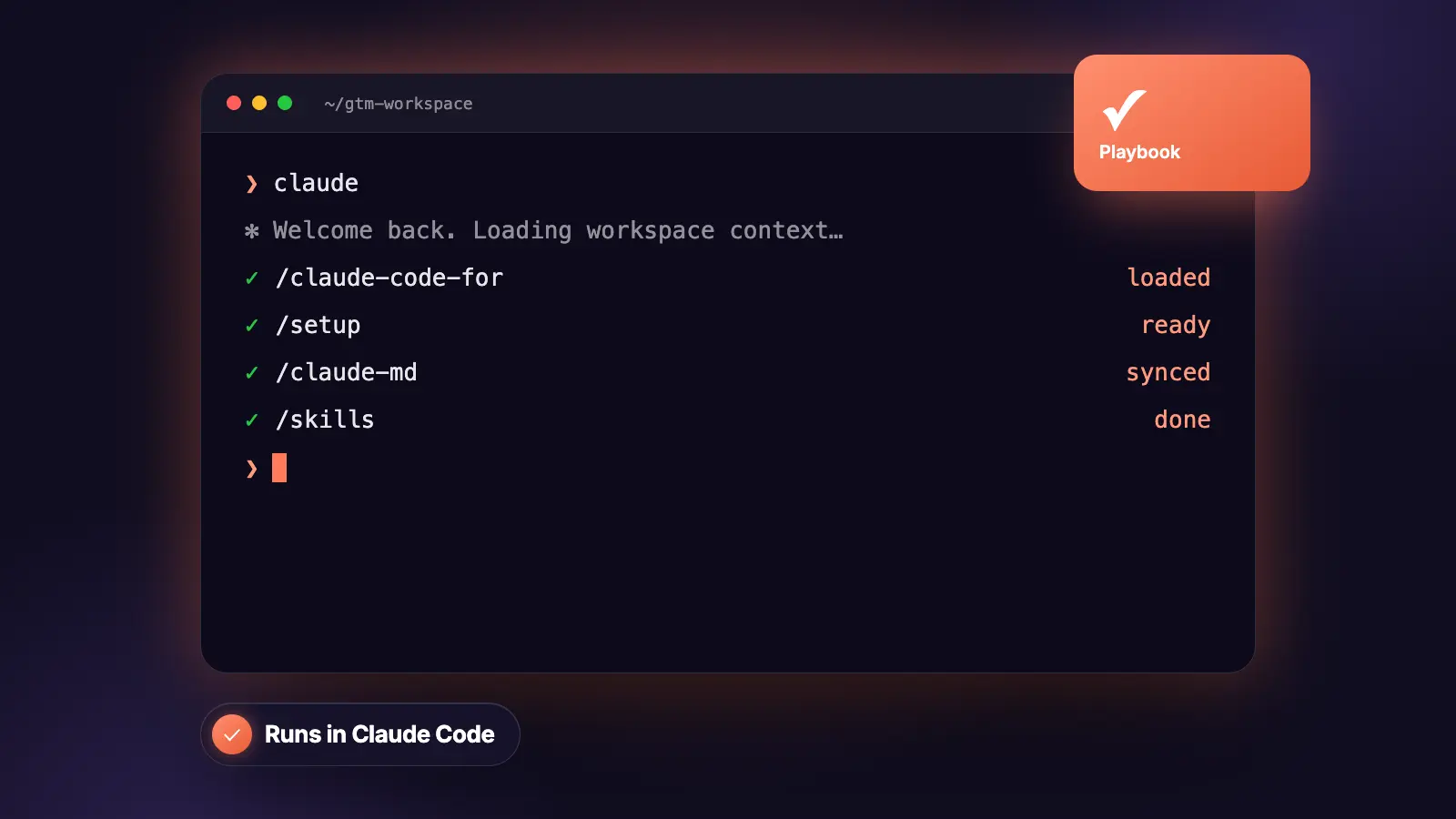
npm install -g @anthropic-ai/claude-code
# or use the native installer for your OS

# Launch
claude

Three ways to use it: Claude Desktop toggle (simplest, least customisable), raw terminal (most powerful, least friendly), or an IDE like VS Code (recommended: full terminal power with a visual file browser alongside it).

Setting up your marketing workspace

mkdir marketing-ops && cd marketing-ops
mkdir -p .claude/skills
mkdir -p campaigns content/drafts content/published reports
claude

One dedicated project folder becomes the home for every campaign asset, content draft, and report going forward. Everything Claude creates or edits is visible in the file explorer, so you see exactly what changed after every instruction.

Session commands

claude              # start a new session in the current folder
/resume             # resume the most recent previous session
/clear              # wipe context and start fresh

Keep one session per campaign or workstream rather than one giant ongoing session for everything. A content-planning session and a reporting session pollute each other's context if run together.

Section 3

Module 2: CLAUDE.md, The Context File Every Session Reads

The one file every skill and agent in this course reads before doing anything. Get this right once and everything downstream inherits it automatically.

The CLAUDE.md template

# CLAUDE.md - Marketing Operations

## ICP
Title(s): [exact titles]
Company type: [B2B SaaS / agency / other]
Company size: [employee range]
Geography: [regions]
The specific problem they have right now: [in their words]
Where they spend time online: [creators/publications they follow]
Disqualifiers: [what rules someone out immediately]

## Offer
[What you sell, in one sentence]

## Brand voice
WE ARE: [3-5 adjectives]
WE ARE NOT: [3-5 anti-adjectives]
Banned: no em dashes, no hashtags in post bodies, no: leverage, synergy,
bandwidth, genuinely, honestly, straightforward
British English. One idea per line. Three lines maximum per paragraph.

## Content rules
No AI-slop phrasing: no rhetorical question openers, no triple-adjective
stacks, no generic superlatives without a number attached.
Every piece needs one specific detail only the author could include.

## Reporting rules
Translate internal jargon into client language. Never hide a problem;
state what happened and what we are doing about it.

Building it through an interview instead of writing it yourself

"Interview me one question at a time to build CLAUDE.md: ICP, offer,
brand voice rules, banned phrases, and content rules. Save the finished
file once complete."

Letting Claude interview you produces a more complete file than writing it from a blank page, since it asks follow-up questions on anything vague.

Section 4

Module 3: Permission Modes and Autonomous Goals for Marketing Work

Four permission levels controlling how much Claude Code can do without asking first, plus the /goal command for self-correcting marketing asset builds.

The 4 permission modes

Plan mode: Claude researches and plans but makes no edits until you approve. Best for campaign architecture and new content concepts.

Accept Edits mode: Claude creates and edits files directly but asks before running commands. Best for building out drafted assets.

Auto mode: edits and runs commands automatically with an internal safety check. Best for validated, repeatable workflows like a weekly content batch.

Bypass Permissions mode: full autonomy, no safety review. Only for sandboxed testing, never for anything touching a live CRM or ad account.

Switch modes with Shift+Tab inside any session. Start every new campaign in Plan mode, move to Accept Edits once approved, and only reach for Auto once a workflow is validated.

Autonomous goals with /goal

Normally Claude generates an output once and hands it back for you to judge. With /goal, an internal evaluator checks the output against requirements you defined upfront, and loops automatically until the bar is actually met.

# Example: a batch of ad variations that must all pass a structural checklist
"Generate 10 ad copy variations for [OFFER].
Requirement: each must include a hook in line 1, a specific number or
proof point, and one clear CTA. Under 150 characters each.
Use /goal to check every variation against this requirement and
regenerate any that fail until all 10 pass."
Section 5

Module 4: Skills, Installing from GitHub and Building Your Own

How to install skills from GitHub, and the description-as-trigger principle that determines whether a skill actually activates.

What makes a good skill description

The description field is what Claude reads to decide when to load a skill automatically. Write it as a specific trigger situation, not a topic.

Wrong: "For content creation"

Right: "When I paste a video transcript and ask for social posts, load this skill"

Installing a skill from GitHub

# Universal method, works for most public skill repos
npx skills add [github-owner]/[repo-name]

# Claude Code plugin method
/plugin marketplace add [github-owner]/[repo-name]
/plugin install [plugin-name]@[marketplace-name]

# Manual clone and copy
git clone https://github.com/[owner]/[repo].git
cp -r [repo]/skills/* .claude/skills/

Building your own skill through an interview

"Interview me about [PROCESS I REPEAT]: what triggers it, what a good
output looks like, what always happens and never happens. Write the
complete SKILL.md with name, description, and instructions."
Section 6

Module 5: GTM Agents, 92 Agents and 52 Skills from a Real Marketplace

Source: github.com/gtmagents/gtm-agents (MIT licence, 345+ stars, Apache 2.0). A production marketplace of 67 plugins, 92 agents, and 52 skills covering the full GTM function, with 19 multi-agent orchestrators.

Install

/plugin marketplace add gtmagents/gtm-agents

# Marketing-relevant plugins
/plugin install content-marketing        # 6 writing skills
/plugin install email-marketing          # 4 automation skills
/plugin install social-media-marketing   # 5 skills: LinkedIn, X, calendars
/plugin install seo                      # keyword research, on-page, technical
/plugin install marketing-analytics      # attribution, ROI, dashboards
/plugin install brand-strategy           # 5 skills: platforms, creative systems
/plugin install competitive-intelligence # research, battlecards, win/loss

The content-marketing skill in full

From the repo: 6 skills covering seo-writing, thought-leadership, case-studies, whitepapers, webinars, and storytelling. Each triggers automatically based on the task description, no slash command required.

"Using the content-marketing plugin, write a thought-leadership piece on
[TOPIC] for [ICP]. Apply the seo-writing skill for search intent and the
storytelling skill for the SCAR structure (Situation, Complication,
Action, Resolution)."

Model routing built into the marketplace

58 of the 92 agents run on Haiku (fast execution, data processing), 34 run on Sonnet (strategy, creative work). The orchestration pattern: Sonnet plans, Haiku executes, Sonnet reviews. This is built into how the marketplace routes tasks, not something you configure manually.

Section 7

Module 6: Building a Marketing Team of Agents

Reused and adapted from the existing Claude for Marketing System lead mag in this workspace, covering how to design and build a coordinated team of agents rather than one general-purpose assistant.

Designing the team

Four steps: map the marketing tasks you do every week, turn each repeatable one into a skill, group non-overlapping skills into distinct agent roles, then connect the agents by updating project instructions so Claude knows who does what.

A reasonable starting team: a content strategist and research agent, a presentation and document agent, a data analysis agent, a social and creative design agent, and a campaign/SEO writing agent. Each gets a single, non-overlapping role.

Building agents step by step

Load brand context files (voice guide, ICP, strategy) into a context folder before building any agents. Create agents using the built-in agent command inside Claude Code: describe its purpose, select its tools, pick its default model, specify where its memory lives.

Once several agents exist, add explicit routing rules to your project instructions: which agent handles which type of request, and what phrases trigger delegation to each one.

Running the team together

"Research [TOPIC], then write a blog post and build a presentation deck
from the findings."

A single complex request like this gets automatically broken down: the research agent runs first, then the content and presentation agents pick up the output once research is complete, producing a coherent set of deliverables that all trace back to the same findings.

Section 8

Module 7: MCP and Connecting Your Marketing Stack

How Claude Code connects to the actual tools a marketing stack runs on.

Native integrations first

Start with native integrations (Gmail, Calendar, Drive) whenever available: zero setup, lowest risk. Move to official MCP servers (Notion, HubSpot, Google Analytics) when no native option exists. Only reach for community-built servers when there is a genuine gap, and grant minimal necessary permissions regardless of method.

Connecting analytics and CRM data

# Example: connect Google Analytics via MCP, then ask directly
"Pull last 7 days of traffic by channel from Google Analytics.
Compare to the previous 7 days. Flag any channel with a significant
drop and suggest why."

Once connected, Claude Code queries live data the same way it reads local files, no manual export required.

Section 9

Module 8: Content Production Workflows

The content production system reused from the Multi-Platform Content System module, adapted for Claude Code specifically.

Content repurposing as the highest ROI starting point

"Read every file in content/source/. For each, repurpose into:
3 LinkedIn posts (different hook mechanisms), 1 X thread, 1 newsletter
section. Apply CLAUDE.md brand voice. No em dashes. Save to
content/drafts/{source-filename}/"

Batch carousel and ad creative production

Set up a style library folder with visual references, and a content planner spreadsheet tracking status per piece. Claude Code batch-generates multiple carousels or ad creatives in parallel, updating the planner with output paths as it finishes each one.

For ad creatives specifically, generate a creative brief first (audience, key message, hook variations) before producing visuals, to keep a batch strategically consistent rather than loosely related images.

SEO content generation to publishing

Generate a content brief (topic, keyword, structure, AI Search notes) before any full draft. Push finished drafts and header images to a CMS as drafts through an MCP connection, ready for human review before publishing. Always add unique data and original insight before shipping an AI-generated draft.

Section 10

Module 9: LinkedIn, SEO, and RevOps Workflows

Three complete workflows reused from the existing LinkedIn, SEO, and RevOps lead mags in this workspace, condensed for the marketing generalist running all three from one Claude Code project.

LinkedIn: the 4-skill outreach and content system

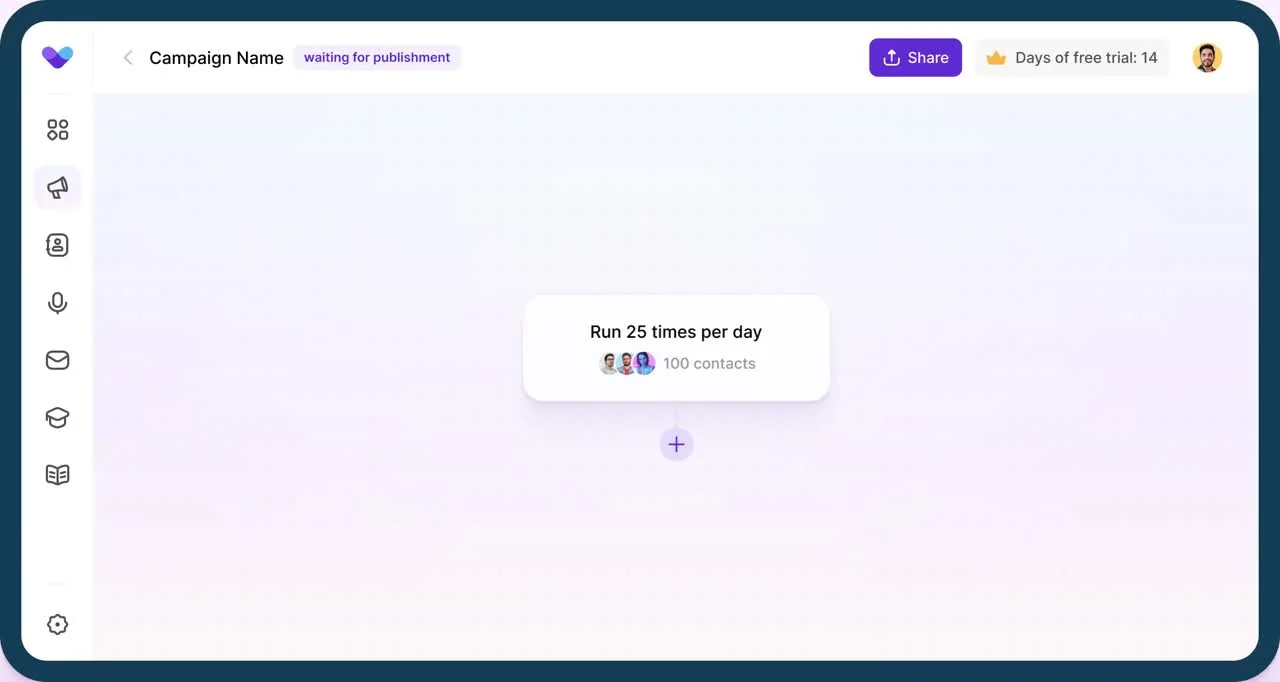
linkedin-outreach (full campaign from ICP to sent connections), linkedin-high-intent (outreach to post engagers), linkedin-feed-engage (auto-comment warmup), linkedin-enrich (bulk profile enrichment). All share daily caps and 30-day dedup logs.

mkdir -p .claude/skills/{linkedin-outreach,linkedin-high-intent,linkedin-feed-engage,linkedin-enrich}
mkdir -p campaigns enrichments

SEO: seranking/seo-skills (26 skills, MIT, 100 stars)

/plugin marketplace add seranking/seo-skills
/plugin install seo-skills@seranking
/mcp   # sign in via OAuth, no API token needed

The documented agency chain: seo-competitor-gap-analysis to seo-keyword-cluster to seo-content-brief to seo-backlink-gap to seo-ai-search-share-of-voice run quarterly, composing into a full seo-plan roadmap.

RevOps: NEON-Rutger/B2B-revops-skills (28 skills, MIT)

git clone https://github.com/NEON-Rutger/B2B-revops-skills.git
cp -r B2B-revops-skills/*/ .claude/skills/

Always run revops-diagnostic first to find the actual constraint before loading a specialist skill to fix it.

Section 11

Module 10: Managing Context and Version Control

How to keep long marketing sessions from degrading in quality, and how to protect campaign assets with version control.

Context management

/context     # detailed breakdown of context usage by category
/compact     # summarizes conversation to free up context space

Watch the percentage in your status bar. Once it crosses roughly 50%, either start a fresh session for the next task or run /compact. Note that /compact summarises rather than preserves everything verbatim, so specific detail (an exact brand rule agreed earlier) should live in CLAUDE.md rather than depend on surviving a compact.

Version control as a safety net

"Create a private GitHub repository for this project folder and commit
the current state."

Every future change becomes a named commit you can inspect, diff, or revert. If a campaign asset goes in the wrong direction, paste the old commit ID and ask Claude to revert that specific asset rather than manually reconstructing what it looked like before.

Section 12

Quick Reference: Full Build Order and Every Install Command

The full course condensed into a build order, plus every install command in one place.

The 4-week build order

Week 1: install Claude Code, set up your marketing workspace folder, write CLAUDE.md through the interview method.

Week 2: install gtm-agents and pick 2-3 relevant plugins for your immediate bottleneck. Build your first 2 custom skills through the interview method for anything not already covered.

Week 3: build your first 2-3 agents with distinct roles and write routing rules. Connect your first MCP tool (analytics or CRM).

Week 4: install the LinkedIn, SEO, or RevOps skill repo matching your biggest need. Set up version control. Test a full multi-step request that requires several agents or skills chaining together.

All install commands in one place

# Claude Code
npm install -g @anthropic-ai/claude-code

# GTM Agents marketplace
/plugin marketplace add gtmagents/gtm-agents
/plugin install content-marketing
/plugin install email-marketing
/plugin install social-media-marketing
/plugin install seo
/plugin install marketing-analytics

# SE Ranking SEO skills
/plugin marketplace add seranking/seo-skills
/plugin install seo-skills@seranking

# RevOps skills
git clone https://github.com/NEON-Rutger/B2B-revops-skills.git
cp -r B2B-revops-skills/*/ .claude/skills/

# Session and context commands
/resume
/clear
/context
/compact

# Permission modes
# Shift+Tab to cycle: Plan -> Accept Edits -> Auto -> Bypass Permissions
8 sessions left · booking closes in

Build it live with a GTM engineer

45 minutes, screen shared, on your own list. You leave with a working campaign or agent, not a set of notes.

5/5 rated on Capterra·800+ agencies and sales teams·Set up in 5 minutes
8 GTM engineer sessions left this monthTry Prosp Free