


Done-for-you buildA specialist builds your first campaign · 6 build slots left · closes in Claim a build slot

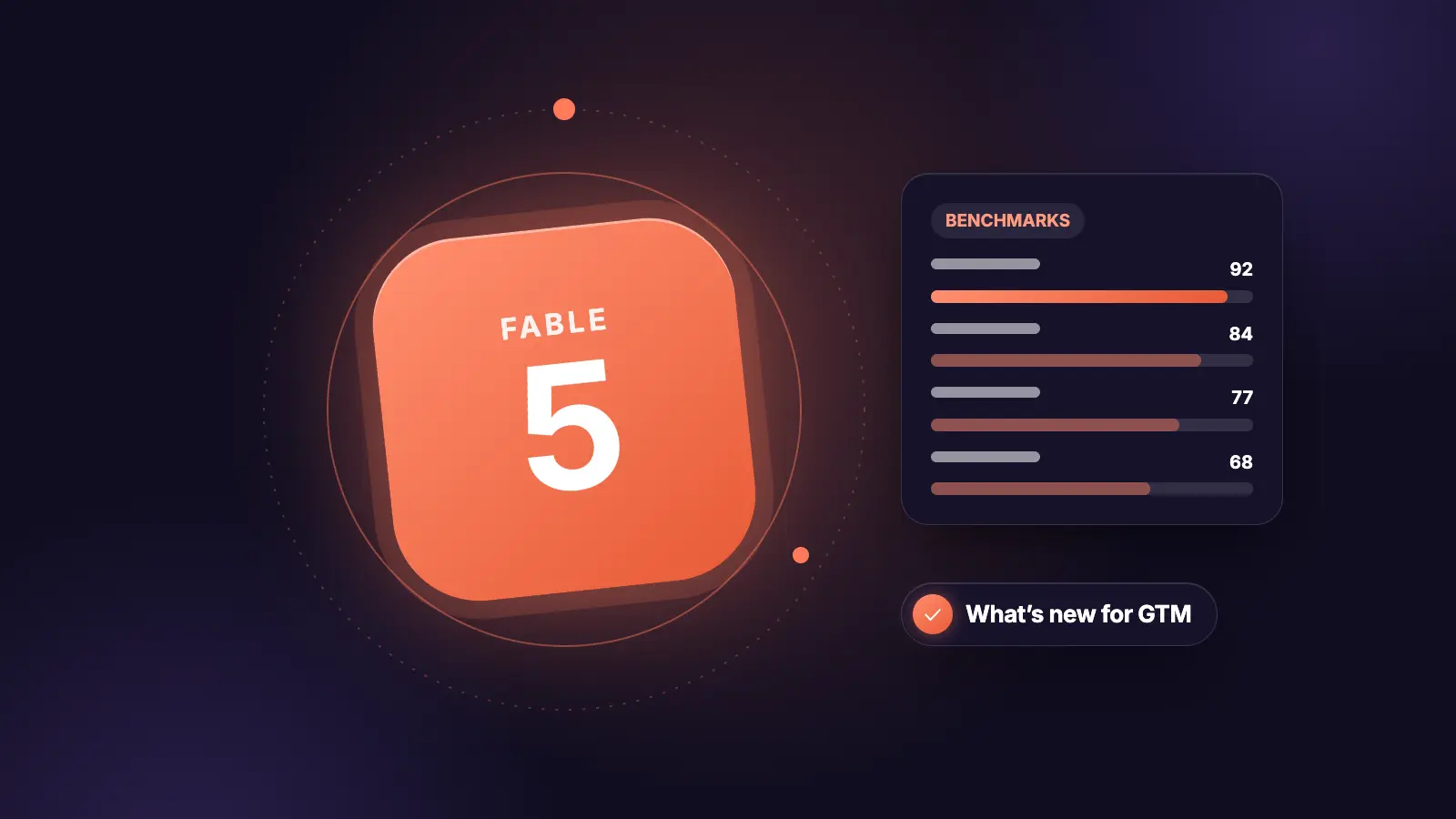
Claude Fable 5 for GTM Engineers: Audit and Improve Your Entire Claude Code Setup

Source: YouTube transcript — "5 Fable 5 Use Cases You Need To Try This Week"

Try Prosp Free3 working days to live · 6 slots left this week
5/5 rated on Capterra·Used by 800+ agencies and sales teams
Guide6 sections
Section 1

Why This Matters for GTM Engineers

Source: YouTube transcript — "5 Fable 5 Use Cases You Need To Try This Week"

Model: claude-fable-5 (access via Claude Max plan through July 7, 2026)

Usage limit: up to 50% of your weekly plan limit while on Max access

Of the 5 use cases covered in the source video, one is directly built for GTM engineers and Claude Code power users: pointing Fable 5 at your past sessions to diagnose what you are doing wrong, what automations are missing, and what skills need to be created or fixed.

This playbook covers that use case fully, plus the four supporting Fable 5 workflows that make every other GTM Claude Code project faster.

Why Fable 5 changes the game for Claude Code power users

Fable 5 is not an incremental upgrade. It is the first model that can operate autonomously across long sessions without stalling, re-deriving settled facts, or requiring constant check-ins. For GTM engineers running skills, automations, and multi-step workflows in Claude Code, this changes what is actually possible in a single session.

The three things Fable 5 does better than any previous model for GTM work:

  1. Long-horizon autonomous execution

Fable 5 can run a complex multi-step workflow from start to finish without stopping to ask for confirmation at each step. The /goal command keeps it working until the task is complete, not until it hits a natural pause point.

  1. Cross-session pattern recognition

Fable 5 can read across dozens of previous session transcripts, cluster patterns, and draw conclusions about what is and is not working. Previous models could not do this reliably at scale.

  1. Skill and automation generation from evidence

Rather than asking you to describe what you need, Fable 5 infers it from observed behaviour across your sessions and writes the skill or automation directly.

How to use Fable 5 within your weekly usage limit

Fable 5 via Max plan caps at 50% of your weekly limit through July 7, 2026. Every token counts.

The strategy from the source video: use Opus 4.8 for the planning and research stages, hand the output to Fable 5 for the execution stages.

# Planning stage: Opus 4.8 with /research or dynamic workflows
# Opus figures out what to build, writes the PRD or execution prompt
# This consumes Opus tokens, not Fable 5 tokens

# Execution stage: Fable 5 with /goal
# Hand Fable 5 the completed plan
# It executes autonomously until the task is done
# /goal is for long-running agentic tasks and big projects

What not to do: do not use Fable 5's dynamic workflows (sub-agent spawning) for research or planning tasks. Sub-agents consume tokens rapidly. Use Fable 5's long-horizon execution capability, not its orchestration capability, for most GTM work.

Section 2

The Core Use Case: Audit Your Past Sessions

The highest-leverage use of Fable 5 for Claude Code power users: read your past sessions, diagnose what is wrong with your setup, and output a prioritised list of improvements before executing anything.

What the audit does

Fable 5 runs across all your previous Claude Code session transcripts using sub-agents to pull raw signals. It clusters those signals across sessions and makes a decision per cluster:

  • This cluster needs a new skill
  • This cluster needs a new automation
  • This cluster needs a fix to an existing skill
  • This cluster needs nothing (you are handling it correctly)

From the source video: one run across 39 sessions returned three batches of improvements ranked by leverage. The improvements ranged from creating new skills to setting existing skills as automations to small changes in CLAUDE.md.

The audit runs in diagnosis mode first. You see what it found before it executes anything. You approve before it changes or creates anything.

The audit prompt

From the source video (Anthropic's official Fable 5 prompting guide informs the structure):

"Reflect on my past Claude Code sessions to find the highest-leverage improvements to my setup.

Use sub-agents to pull raw signals from the transcripts.
Cluster signals across sessions.
For each cluster, decide: new skill / new automation / fix to existing skill / nothing.

Write all candidates to improvements.md with:
- Cluster name
- Signal count (how many sessions showed this pattern)
- Leverage tier (high / medium / low)
- Recommended action
- Specific change or skill to create

Diagnosis only first. Do not execute anything. I will review improvements.md and decide what to proceed with."

Running the audit

# Step 1: Open Claude Code Desktop, switch to Fable 5
# Step 2: Paste the audit prompt above
# Step 3: Fable 5 reads session transcripts using sub-agents in parallel
# Step 4: It writes improvements.md to your project root
# Step 5: Review improvements.md before approving any execution

# After reviewing, approve specific items:
"I have reviewed improvements.md. Proceed with the high-leverage items only.
Create the skills and automations listed under HIGH tier.
Do not touch the medium or low tier items yet."

What Fable 5 typically finds for GTM Claude Code users:

  • Repeated manual tasks that should be skills (account research, proposal drafting, CRM updates)
  • Skills that are being run manually every session that should be automations
  • CLAUDE.md entries that are outdated or missing context about the current ICP or offer
  • Tasks where the prompt varies each time but the structure is the same (template opportunity)
  • Sessions where Fable 5 stalled and asked questions that CLAUDE.md should have pre-answered
Section 3

From Audit to Action: Building Skills and Automations

After the audit identifies what to build, use Fable 5 to build it. This section covers how to go from the audit output to working skills and automations.

Converting audit findings into skills

"Read improvements.md. For each HIGH tier item marked as 'new skill':

1. Read the session transcripts where this pattern appeared
2. Extract the recurring inputs, the recurring task structure, and the recurring output format
3. Write a SKILL.md for this skill following the intent-and-boundary format:
   - State the outcome the skill produces
   - State the boundary conditions (what it does not do)
   - Include copy-paste prompts as examples
   - Keep it to one screen. Remove anything that does not change behaviour.
4. Save to ~/.claude/skills/[skill-name]/SKILL.md
5. Show me each skill before writing it to disk"

Converting recurring tasks into automations

"Read improvements.md. For each HIGH tier item marked as 'new automation':

1. Identify the trigger: what event starts this task? (new day, post published, connection accepted, reply received)
2. Identify the action: what does the task do when triggered?
3. Identify the output: where does the result go? (CRM, Notion, Slack, email)
4. Write the automation as a Claude Code hook or schedule
5. Show me the automation spec before implementing it"

Updating CLAUDE.md from session evidence

"Read my CLAUDE.md and my last 20 session transcripts.

Identify:
1. Questions Fable 5 asked that CLAUDE.md should have already answered
2. Context I re-provided across multiple sessions that should be stored permanently
3. Decisions I made repeatedly that should be codified as rules
4. ICP or offer details that have changed since CLAUDE.md was last updated

Produce a diff: what to add, what to remove, what to update in CLAUDE.md.
Show me the diff before writing anything."
Section 4

Running Long GTM Workflows with /goal

Once your skills and automations are up to date, use Fable 5's /goal command to run long agentic GTM workflows without babysitting them.

/goal: the right command for long GTM tasks

/goal is the Claude Code command designed for long-running agentic tasks. It keeps working until it reaches the success criteria you define, not until it hits a natural pause.

For GTM engineers: use /goal when the task has multiple steps, is already well-defined, and does not need your input at each step.

The success criteria must be specific. "Build the outreach system" is not a success criterion. "Every prospect in the attached CSV has a signal-triggered connection note drafted and queued for my approval" is a success criterion.

/goal prompt template for GTM workflows

/goal

Task: [DESCRIBE THE FULL MULTI-STEP TASK]

Success criteria:
- [SPECIFIC MEASURABLE OUTCOME 1]
- [SPECIFIC MEASURABLE OUTCOME 2]
- [SPECIFIC MEASURABLE OUTCOME 3]

Boundaries:
- Do not send anything without my approval
- Do not make CRM changes until I confirm the draft
- If you hit a blocker that requires input, stop and describe it

Context: read CLAUDE.md for ICP, offer, voice, and campaign history.

GTM /goal examples

# Weekly account research run
/goal

Task: Research each company in accounts-this-week.csv. For each, produce an account brief.

Success criteria:
- Every company has a brief covering: what they do, size, funding stage, recent signals, decision maker, recommended outreach angle
- All briefs are written to ./briefs/{company-name}.md
- A summary table is written to ./briefs/index.md ranking companies by ICP fit and signal strength

Boundaries:
- Do not reach out to any company
- If a company has no findable signals, note that rather than inventing any
# Full cold email sequence build
/goal

Task: Build a 6-touch cold email sequence for each persona in personas.md.

Success criteria:
- Each persona has a full 6-email sequence: Day 1/4/9/16/25/35, different angle per touch, subject line variants per email
- All sequences are written to ./sequences/{persona-name}.md
- A QA score out of 100 is calculated for Email 1 of each sequence. No sequence goes forward if Email 1 scores under 80.

Boundaries:
- No em dashes in any email
- No generic openers
- Read CLAUDE.md for voice and ICP before writing any email
# Post-publish LinkedIn engagement run
/goal

Task: After my LinkedIn post goes live, monitor who engages and queue outreach.

Success criteria:
- All engagers who match my ICP from CLAUDE.md have a connection note drafted and queued
- ICP-matching engagers are ranked: commented > shared > liked
- All drafts are in ./outreach/pending-approval/ for my review
- Nothing is sent until I manually approve each item

Boundaries:
- Tier 1 (commented or shared): draft within 6 hours
- Tier 2 (liked 3+): draft within 48 hours
- Do not send anything, only draft and queue
Section 5

The Opus Plan + Fable 5 Execute Pattern

The Opus + Fable 5 workflow for projects that are too complex or expensive to hand directly to Fable 5 cold.

The Opus research → Fable 5 execute pattern

The key insight from the source video: you do not need to burn Fable 5 tokens on research and planning. Opus 4.8 can do the upfront work. Fable 5 executes the plan.

# Stage 1: Opus 4.8 research and planning
# Switch to Opus 4.8 in Claude Code Desktop
# Use /research or dynamic workflows

"Using /research, build a detailed execution plan for [GTM PROJECT].
Research: [what needs to be understood before building]
Plan: [the step-by-step build sequence]
Success criteria: [how we know the project is complete]
Output format: a /goal-ready prompt I can hand directly to Fable 5."

# Opus returns a structured /goal prompt
# Stage 2: Switch to Fable 5, paste the /goal prompt
# Fable 5 executes the plan autonomously

GTM project ideas suited to this pattern

Projects where Opus plans and Fable 5 executes:

  1. Build a custom signal monitoring system

Opus researches: how do job change signals, hiring signals, and content signals get captured from LinkedIn and Clay? What tools need to connect? What does the routing workflow look like?

Fable 5 builds: the n8n workflow, the Clay table, the signal routing logic, and the Claude Code skill that reads the queue each morning.

  1. Clone and customise an existing sales tool

Opus researches: how does [TOOL] work? What are the core features? How would we replicate the core functionality locally?

Fable 5 builds: the local version, fully customised to your workflow, with nothing leaving your machine.

  1. Build your agentic GTM OS

Opus researches: what are your highest-leverage daily tasks? What skills and automations already exist? What is missing? What should be visual vs terminal?

Fable 5 builds: the web interface wrapping Claude Code, the skill panel, the content dashboard, the morning report, the signal inbox.

  1. Code review your existing Claude Code skills

Opus researches: what is wrong with each skill? Which ones are pre-Fable-5 and too prescriptive? Which ones are missing verification hooks?

Fable 5 fixes: rewrites each skill using the intent-and-boundary format, removes capability compensation, adds verification hooks.

Section 6

Quick Reference: All Prompts and Commands

All prompts and commands from this playbook in one place.

Model switching reference

# Use Opus 4.8 for:
# /research tasks
# Dynamic workflow planning
# PRD and execution prompt creation
# Anything where you need deep research before building

# Use Fable 5 for:
# /goal long-horizon autonomous execution
# Session audit and skill/automation generation
# Building projects where the plan is already clear
# Anything requiring multiple sequential steps without stalling

# Do NOT use Fable 5 dynamic workflows (sub-agent spawning) for planning
# Sub-agents consume tokens fast. Use them for execution only.

# Usage limit: 50% of Max plan weekly allocation through July 7 2026
# After July 7: Fable 5 moves to API pricing only

The session audit prompt

"Reflect on my past Claude Code sessions to find the highest-leverage improvements to my setup.

Use sub-agents to pull raw signals from the transcripts.
Cluster signals across sessions.
For each cluster, decide: new skill / new automation / fix to existing skill / nothing.

Write all candidates to improvements.md with:
- Cluster name
- Signal count
- Leverage tier (high / medium / low)
- Recommended action
- Specific change or skill to create

Diagnosis only first. Do not execute anything."

The skill-from-evidence prompt

"Read improvements.md. For each HIGH tier item marked as 'new skill':

1. Read the session transcripts where this pattern appeared
2. Extract recurring inputs, task structure, and output format
3. Write a SKILL.md using intent-and-boundary format:
   - State the outcome (what the skill produces)
   - State the boundary (what it does not do)
   - Include copy-paste prompt examples
   - Keep to one screen. Remove anything that does not change behaviour.
4. Save to ~/.claude/skills/[skill-name]/SKILL.md
5. Show me each skill before writing to disk"

The CLAUDE.md update prompt

"Read my CLAUDE.md and last 20 session transcripts.

Identify:
1. Questions Fable 5 asked that CLAUDE.md should have pre-answered
2. Context I re-provided across sessions that should be stored permanently
3. Decisions I made repeatedly that should be codified as rules
4. ICP or offer details that have changed since CLAUDE.md was last updated

Produce a diff: what to add, remove, and update.
Show me the diff before writing anything."

The Opus plan → Fable 5 execute prompt

# Run on Opus 4.8 with /research:
"Build a detailed execution plan for [GTM PROJECT].

Research: [what needs to be understood before building]
Plan: the step-by-step build sequence
Success criteria: how we know the project is complete

Output: a /goal-ready prompt I can paste directly into Fable 5."

# Then switch to Fable 5 and paste the output as a /goal prompt.

/goal template for GTM workflows

/goal

Task: [DESCRIBE THE FULL MULTI-STEP TASK]

Success criteria:
- [SPECIFIC MEASURABLE OUTCOME 1]
- [SPECIFIC MEASURABLE OUTCOME 2]
- [SPECIFIC MEASURABLE OUTCOME 3]

Boundaries:
- Do not send anything without my approval
- Do not make CRM changes until I confirm the draft
- If you hit a blocker that requires input, stop and describe it
- Read CLAUDE.md for ICP, offer, voice, and campaign history
6 build slots left · closes in

Have your first campaign built for you

Send us your ICP and a Prosp specialist sources the list, writes the sequence and clones your voice. You review every draft before a single message sends.

5/5 rated on Capterra·800+ agencies and sales teams·Set up in 5 minutes
6 done-for-you build slots left this weekTry Prosp Free